
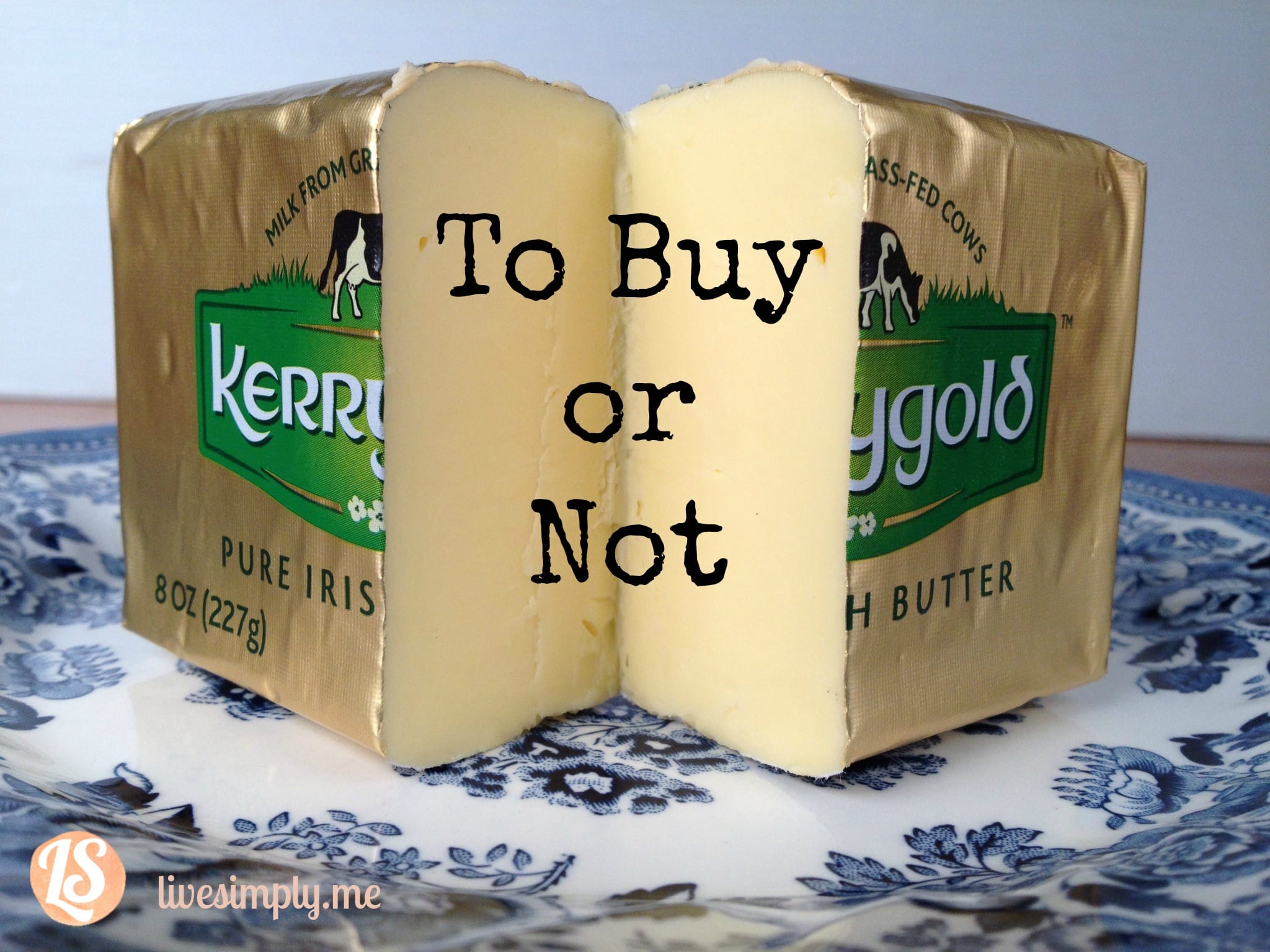
NOTE: This post was one of the first posts shared on Live Simply, making this blogpost over 5 years-old. I still love and purchase Kerrygold butter for my family. That said, I still stand behind the words shared in this post. I welcome comments on this post; however, comments that are rude (a direct insult to me, name calling, or written in a nasty way) will not be approved. Differing opinions are always welcome, rude and insulting comments are not welcome.
I guess I have developed a reputation.
A reputation for loving good high-quality, pastured butter.
Rich, yellow, creamy, delicious butter.
Last week several of my friends sent me, with great concern, a post titled, “Why I Stopped Buying Kerrygold Butter” by hopecentric It is a very well-written post and worth a read. Her two main reasons for no longer buying Kerrygold are:
It’s not 100% grass fed. It is almost 90% grass fed, and supplemented with feed that includes soy and corn.
It’s actually only 97% GM free.
After reading the post, my first reaction was “What?”
“What am I going to do with the pounds of Kerrygold Butter in my freezer? Not 100% grass-fed?”
The writer also suggests several alternatives, such Organic Valley and Natural by Nature as well as a few other brands I haven’t found to be locally available.
I decided to do some investigating!
I was curious!
I wanted to make sure I had my facts straight before calling it quits with my Kerrygold obsession.
If I were to make the switch to a different butter, as the writer suggests, I would be spending double even triple per pound vs. what I am paying for Kerrygold at Costco. I wanted to make sure the higher price of these butters really meant I was getting a better, grass-fed product, free of as many GMO’s as possible.
I realize buying straight from a local farm is always best! For some this may not be an option. For me it is.
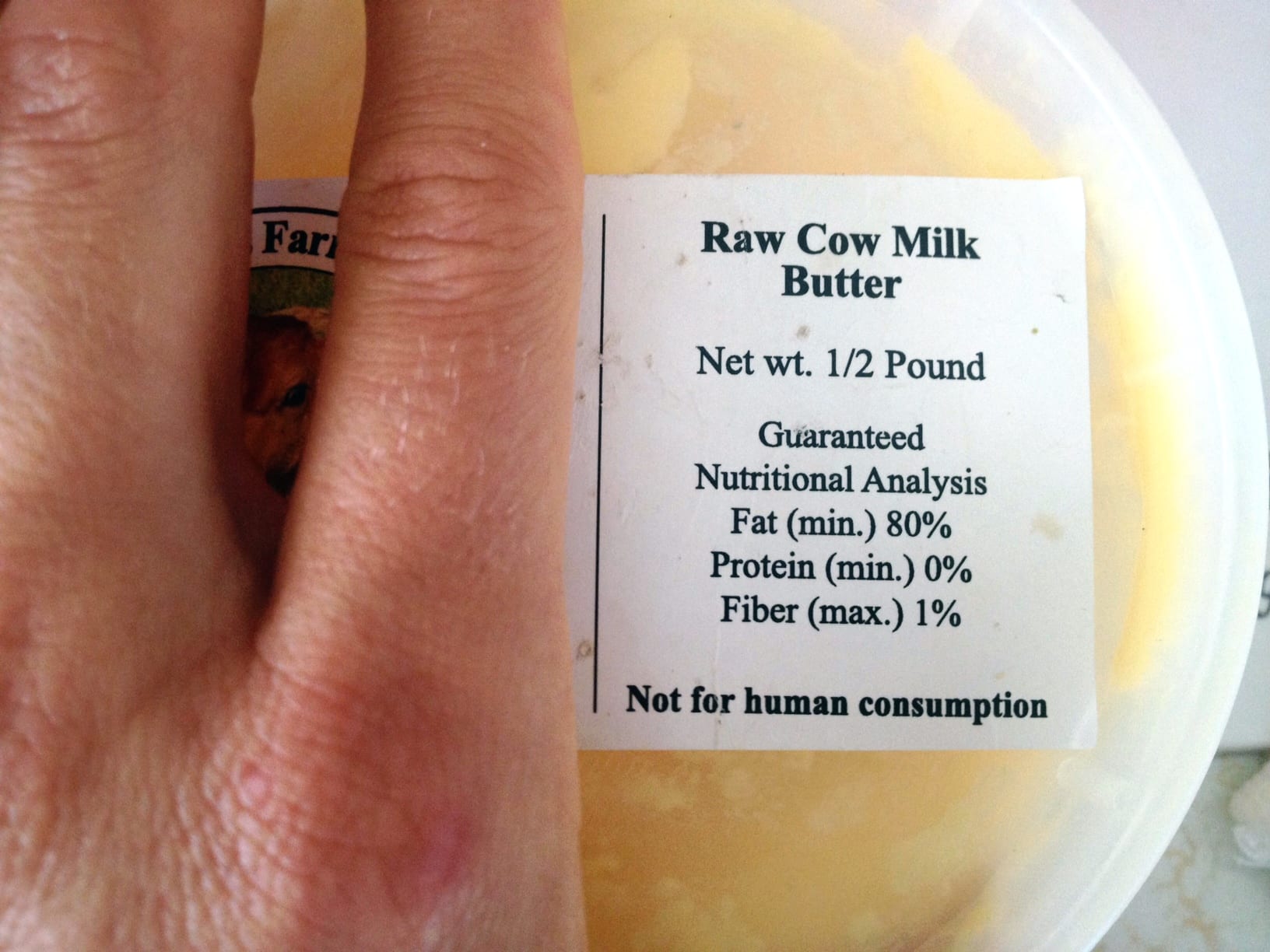
I am able to purchase 1/2lb tubs of butter through my raw milk farmer. I make it a priority in our family’s food budget to purchase raw milk, raw cream, raw sour cream, and raw cottage cheese from this farm. I love supporting a local farm and feel good about how the farm cares for the cows and their pastured lifestyle. There are many times the machine which the farm uses to churn butter simply isn’t working which means no butter. I know, people will write and say,
“Buy the cream and make your own!”
I have done this many times and often when cream is available I purchase it for this reason. But there are times when I just need the convenience of pre-made butter. At $5 for a 1/2lb of butter I can’t afford to purchase lots of this butter.
It’s a special treat!
That’s where Kerrygold comes to the rescue.
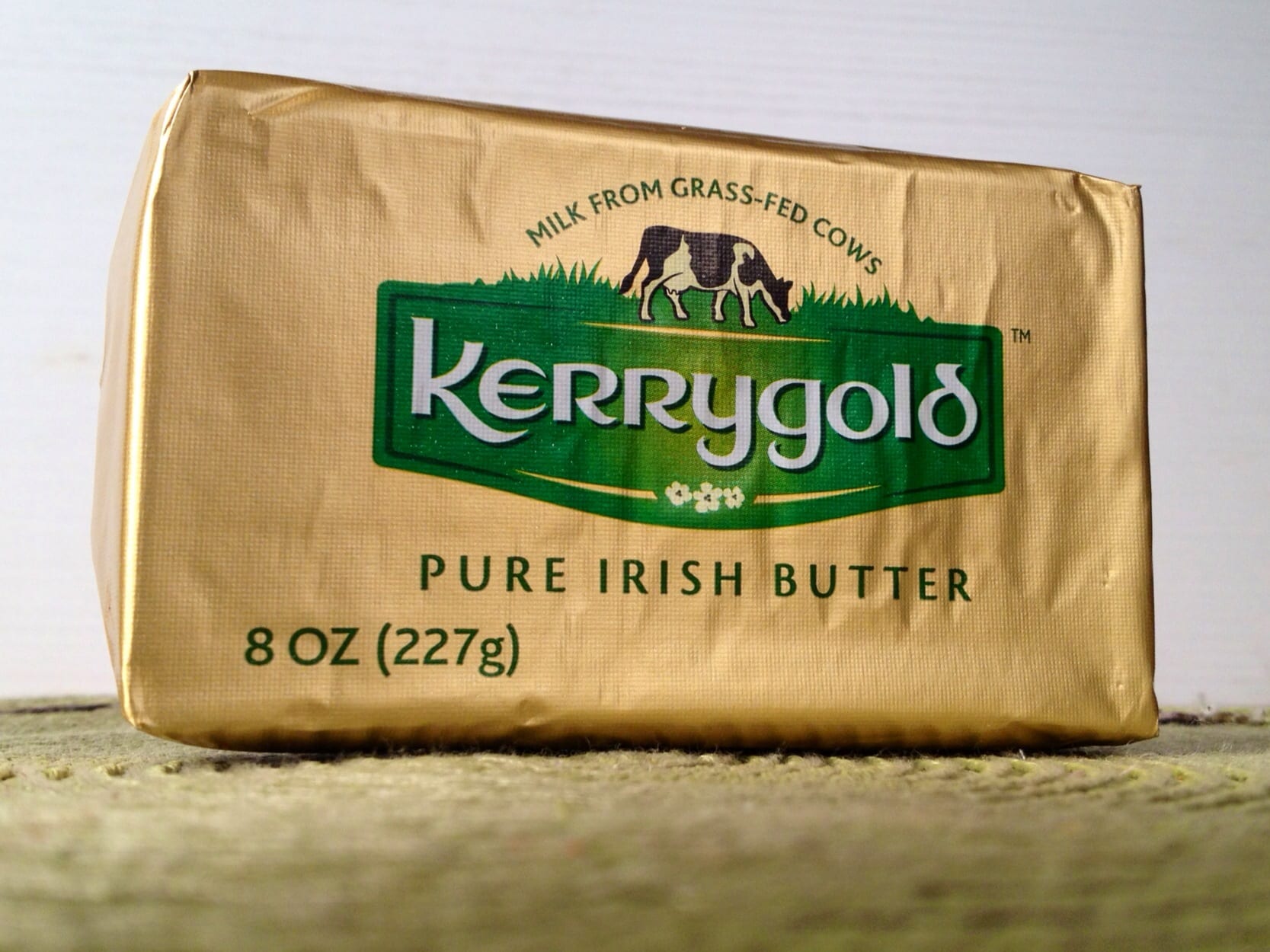
At $6.50 for 3 sticks of butter at Costco, I can feed my family pastured butter without Dustin needing an extra job just to support our butter habit.
I’ll admit, I’ve lost some sleep over the issue of butter this week.
It’s probably not too healthy to loose sleep over butter!
Let’s consider a few things:
1. 90% Grass-Fed: According to Kerrgold,
Approximately 2/3 of the land in Ireland is used for farming and agriculture and 80% of this land is used to grow grass. This grass gives the Irish countryside its green color and is the basis for the description of Ireland as the Emerald Isle. This abundant supply of natural fresh grass is also what makes the Irish dairy industry and Irish dairy products unique.
Irish dairy cows graze on fresh grass in pastures all day long for up to 312 days a year. In fact, Irish cows graze outdoors on grass for longer than almost every country in the world.
I’m not a math wiz, but from my simple calculations this means the cows are supplemented (not consuming grass) only 44 days a year.
I’d say that’s pretty awesome!
I know 365 days of pure pasture grazing would be pretty darn awesome, but let’s think about something…winter!
I’m a Floridian, however, I know enough about winter to know when snow falls grass is going to be scarce which means cows aren’t going to be grazing on grass. Hungry cows need to eat!
Regarding this issue Kerrygold states,
…like so much of what we do, our feeding pattern follows the cycle of nature. During the winter, when grasses stop growing, Irish cows are fed dried grass (known as silage). This grass is grown throughout the year, cut fresh and stored to be used when the winter comes. Cows in Ireland calve in the spring and are therefore outdoors, grazing on green grass when they are producing milk. After calving, cows are provided with supplementary feed to help restore protein and nurture them through this period.
After talking to several farmers here in the States, I am beginning to realize 100% grass-fed with zero supplementation is a nice idea, however, not realistic.
I’m not surprised or disappointed to learn Kerrygold cows are only 90% grass-fed. I am pleased to find affordable, good quality butter that is pastured for 312 days a year on fresh grass!
That’s a lot of grass eating!
2. Supplementing: When the cows are not grazing on fresh grass supplementation is needed. Kerrygold explains what this supplementation is comprised of,
Supplementary feed makes up about 10% of a cow’s diet. The supplementary feed is used to give the cows a healthy and balanced blend of nutrients, providing them with protein, energy and fiber. The majority of the cow’s supplementary feed is from locally grown Irish crops, such as wheat and barley. The balance of this feed can be composed of distillers grain (rapeseed, soy and citrus pulp – a blend of dried peel, pulp and seeds of oranges, grapefruit and other citrus fruit).
3. The GMO Issue: The biggest alarm from the post is the issue of GMO’s. I went straight to Kerrygold:
Our ongoing discussions with the grain and dairy industry have established that of this approximately 10% grain/supplements, approximately 20 to 25% may be from GM sources. This means that approximately 3% of a cow’s total typical annual diet may be from GM sources…
At present, the Irish Dairy Board cannot guarantee that grain supplements used by farmers will all be GM free…
We can confirm that Kerrygold butter and cheese do not contain GM ingredients.
Some have raised concern that even though Kerrygold’s butter may not contain GMO ingredients, the feed may.
I feel comfortable with Kerrygold disclosing that 3% of the annual feed their cows eat may contain GMO’s. Considering the fact that GMO’s are fairly new to Europe and most of the supplementation is coming from local sources of wheat and barely along with possibly corn and soy, I feel confident in this very small percentage.
Our family just recently adopted two laying hens, because of this I also have a great appreciation for how difficult it is to find guaranteed GMO-free feed and the great cost involved in using such feed is amazingly high.
I congratulate Kerrygold for being able to keep this percentage so low.
Bravo!
4. Kerrygold butter comes from fresh Spring cream/milk:
Cows in Ireland calve in the spring and are therefore outdoors, grazing on green grass when they are producing milk.
The cream/milk produced to make butter comes from cows that are grazing on pasture. Cream is not produced and churned into butter during the winter when the cows are being supplemented.
5. Consider the Alternatives: I personally choose not to purchase butter (or meat) based on the organic label alone.
Organic does not equal grass-fed.
Many organic brands of butter, cheese, milk, and meats are nothing more than glorified corn-fed cows, simply free of antibiotics and hormones. Although these products may be GMO-free (organic), the diets of such animals are far from normal or healthy.
I decided to look into a couple other sources for butter.
Pastured, grass-fed sources.
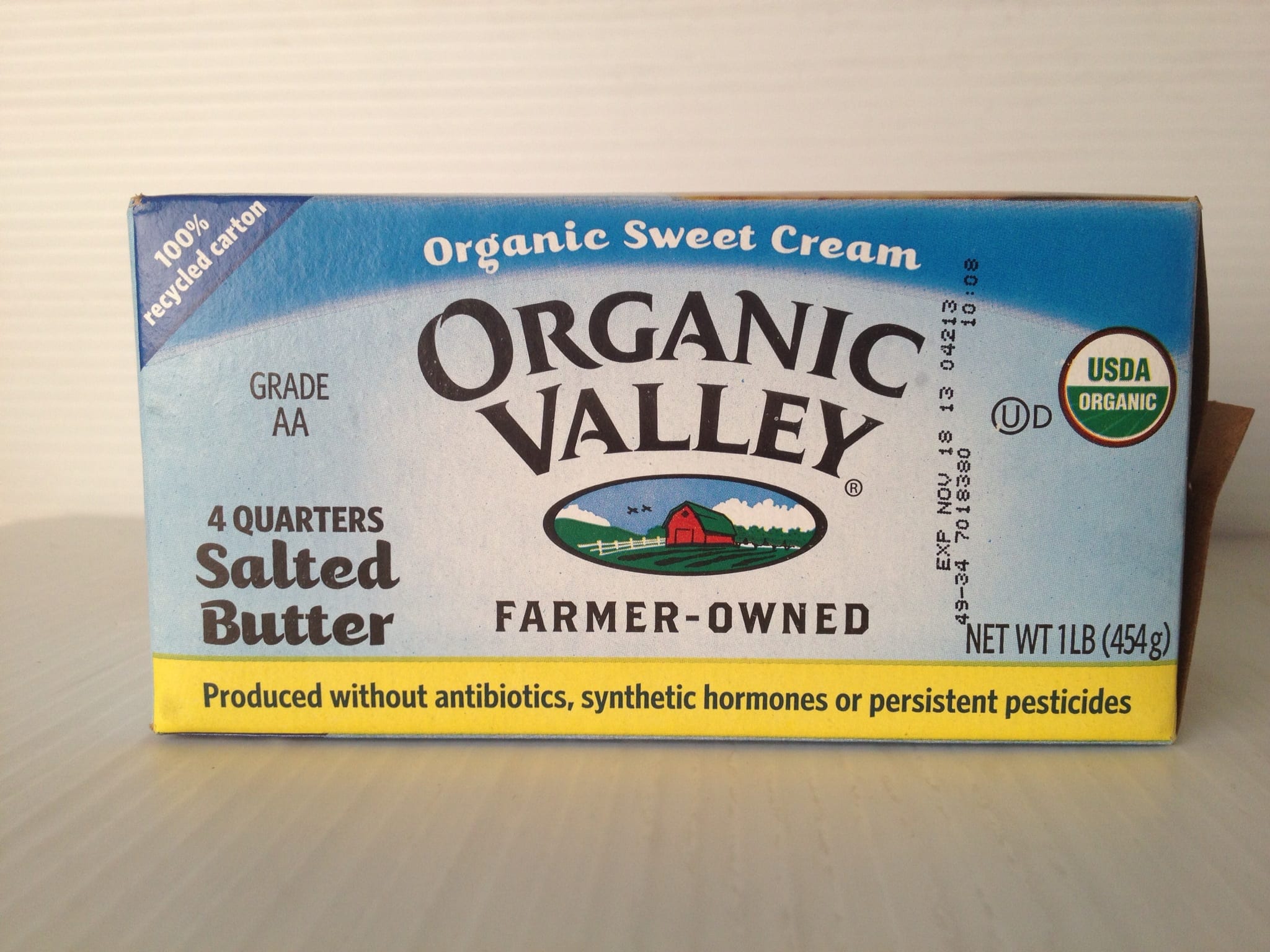
The first, Organic Valley. I spoke to Organic Valley over the phone. I was told the milk/cream used for their line of Pastured Butter is not 100% grass-fed. Just like Kerrygold, Organic Valley supplements with grains including corn and soy. Although they didn’t disclose how much supplementation occurs, they do use GMO-free corn and soy. The representative also confirmed that 100% grass-fed was far from reality for the majority of farmers.
The second source was my local raw dairy farm. Again, I found supplementation to be a small part of the cows diet when needed. The farm also recently switched over to a new organic and GMO-free feed which also drove the cost of the dairy much higher.
Dustin may need to start looking for that extra job now.
To Buy or Not:
After a week of pondering and researching (and loosing sleep) I have decided I will continue to buy Kerrygold.
I feel it’s important to continue to support a company that strives to feed their cows grass, a practice which is not widely practiced today.
While I will pick up a 1/2lb tub of butter from my local farm and stock up on Organic Valley Pastured Butter when on sale, I will continue to confidently buy pounds of the creamy, yellow grass-fed Irish Butter I love so much.
Kerrygold.
I warmly invite you to join our Facebook community, be inspired on Pinterest, and subscribe to the blog.

Not to buy. People rave about this stuff but I don’t get it. I am completely aghast at these exorbitant prices!! “Just $6.50 for 3 sticks” and that is the CHEAP one? Wow. I’ll stay with the butter that is $2 per pound. Even the cheap stuff is better than margarine and fake spreads.
We had to make budget sacrifices to afford something like this. For us this meant spending less on entertainment 🙂
Other good fats to help supplement butter are lard (one can render for one’s self), tallow (again, render for one’s self from beef raised without grain, hormones, etc.) and coconut oil.
We buy from a farmer that is exclusively grass fed. In the winter, that means no bags of grain but plenty of dried grasses, which will contain seed heads/grain but plenty of the rest of the plant as well so it is in balance. It is perfectly possible to feed the cattle without supplementing grain. We live in a climate with winter. What makes it unrealistic is that most people don’t v. can’t. For all of the grain there are the rest of plants that could have been made into hay v. bags of grain. Cost is a factor and we look for the best possible price without sacrificing quality and our health goals. GMO is not something we want to compromise. We live in a little apartment on the lesser side of town, trim our budget in every imaginable way so that we can eat our priorities and homeschool. It is worth once a year hair cuts, old cars, eat simply to eat high quality, no cable/satellite, buy clothes used, etc. Anyway, if one doesn’t have to compromise a good deal is always welcome but GMOs are never acceptable. And grain free dairy is much more healthy than cows that are given any grain, even grain at milking. There are farmers doing this, but one does have to search. Best of luck.
The land is so wet and cold in winter, if they didn’t rotate the cattle
And house them some in winter, the grass would die and not come back in
Spring…then we would have no grass fed Irish beef or butter. (According
To my in laws.)
My father in law has cattle in Ireland. If all farmers are like him, they
Are mostly grass fed, except in winter when he does have to feed them
Some grain…to me, that’s close enough. Kerrygold is so good, I will
Continue to eat it. With a smile.
Thank you for your research and report. I started wondering about this, too. Sorry you lost sleep!
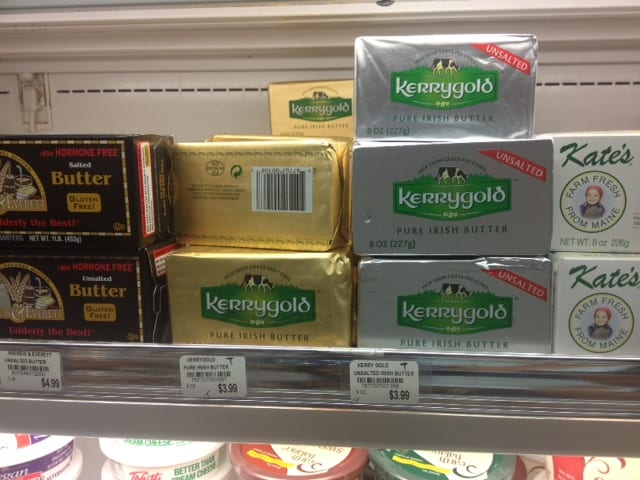
Wish I could afford organic/Kerrygold/anything along these lines on a regular basis. Judging from that shelf label, it is FOUR TIMES as expensive as the “regular” butter I buy. (I know the grass-fed is way healthier, but starving isn’t healthy, either! 😉 )
A while back I was looking into the possibility of getting a cow, and came across a “heritage” breed of cattle called the “Dexter.” These are small cattle (about half the size of “regular” cows) that originated in Ireland, and they apparently can browse some (like goats), so they don’t require as much grass. So it’s probably true that Ireland has less grass, and that if they are trying to raise the same kind of cattle we use here for dairy production it may not be the best. However, Ireland has been producing dairy for centuries – even before they could spray heavily to prevent grass rot (or whatever) – so it really probably depends on how traditional they attempt to remain.
I’m interested in the post that talked about that lady from Dublin who knew the grass was planted and then sprayed. I think you should get to the bottom of that. Today, after having eaten Kerrygold exclusively for the last 6 months, I tried OV Pasture butter again. It was refreshingly a lot less salty than KG, and had a sweetness from its cultures that KG does not have. I want to like KG best because they are the cheapest. But I wish they would salt a bit less, and use sea salt (which it doesn’t say), and I wish we knew more about the way the cows were really and truly raised.
Kerrygold also makes and sells an unsalted butter (no salt). It is sold in a silver package. I can email you the links the lady from Ireland sent me. Is the email listed here a good email to send those to? Unless we buy exclusively from local farms we visit regularly we never know 100% about the conditions and feed and such. We have the information provided for us by these companies to base our decisions on, such as Organic Valley and Kerrygold or any non-local company or farm your purchase from.
Not sure why Costco diesn’t carry the unsalted KG…?
Many Costco stores are very customer orientated. You could put in a request 🙂
I came to the same conclusion as you! 🙂
You mentioned that Kerrygold was cheaper. I for one, would rather pay the farmer and not the doctor, the nurse, the radiologist, etc. Just my reason for buying from the farmer.
I would as well. This is why we purchase most of our food locally and about 97% organic and make everything at home. Kerrygold is paying farmers too 🙂 I am able to support both my local farms, including purchasing most of my raw dairy, and purchase from Kerrygold farmers as well :). I would love to purchase 100% local, but for me that isn’t always possible due to various factors. If this is possible for you, that is fantastic!
UMMM why does the container of Raw butter say “not for human consumption”? Am I just duh or what? lol
Raw dairy is illegal in many states. Florida decided to mark raw dairy as for “pet consumption” or “not for human consumption”. This allows farmers to sell it legally, just under the idea people are not consuming it. Raw dairy is considered “dangerous” by many in big government. You can read more here: https://livesimply.me/index.php/category/real-food/investigations/
Thanks! We buy Kerry gold from Costco, occasionally organic valley pasture on sale. We do get raw milk but the butter is $24/lb and I simply can’t do that.
Awesome post!! I love all the research and I love my Kerrygold. I’m keeping my delicious yellow creamy butter 🙂
Agree completely. Thank you for jumping in and doing the research.
Fantastic post. I came to the same conclusion.
Thank you for doing all that research, I absolutely loved your article! And I agree — I’m going to keep buying Kerry Gold Butter 🙂
I totally agree with you =)
Oddly enough I found this site via a woman in Dublin who does the Facebook page for the WAPF chapter there. She has your Kerrygold post on their site. We began corresponding when I traveled to Ireland this past spring. I contacted the chapter to find out about some good real food restaurants in Dublin. When I returned to the States we wrote a bit about things here and there and naturally butter came up, grassfed butter and Kerrygold in particular since I had been buying it here recommended by other WAPF people. Well, according to Katrina, from Dublin, just about all of the grass there is not natural but planted. She claims the pastures are plowed and planted with rye grass for the cattle and that it is not organic and it is heavily sprayed with things to keep it healthy. Apparently the really wet weather causes a lot of grasses to rot, mold, etc., and the cows and cattle cannot consume it. This past spring was so wet and cold, crops failed and there was a “fodder crisis.” Ireland actually had to import hay from you guessed it….the US! Other countries shipped hay in also and Katrina claims once again, NOT organic, so probably GMO and sprayed with pesticides. This really bummed me out after seeing all this “lush” pasture with cows and sheep munching away. It makes a pretty picture but it appears to have a dark side. Katrina said the the Kerrygold operation is so very huge, it can’t be that great and she doesn’t trust them. This Dublin lady buys her organic butter from France and England! So, the verdict is not out about Kerrygold just yet.
Mikki
Thank you for sharing. Very interesting. I think that’s the reality of farming. Crops get washed out, grass doesn’t grow, and supplementation often occurs. I’ve seen it often here in Florida with local farms I buy from. I know from several Irish friends that Kerrygold is not considered anything special in Ireland, just normal table butter, but for me, with a desire to eat butter from cows raised as close to natural God-given conditions as possible, this often is the best I can provide, and far superior to the other choices I have. Right now grass (hay) and barley are not on the top of the GMO’s being produced, so that is a relief. I know it’s impossible to find “organic” hay for our chickens which they sometimes consume. I too have questioned the size of Kerrygold, but I have no problem with a company such as Organic Valley which is much larger, along with a few other large scale organic companies. I truly believe good farming practices can be practiced whether you are a large scale company with hundreds to thousands of farms or a small local farm. Would you mind sharing her site where this post is being shared? I’d love to check it out. Thank you 🙂
Did you get the links you wanted about this I sent to your e-mail? Didn’t hear back.
I wonder if Kerrygold is a very large company or whether it is a consortium of many farmers who join together to package and market the products.
The climate in Ireland is very similar to that of western Washington state. The cows here are out at pasture year around although there are a few months when grass is not growing much and they are fed grass which has been made into silage.
With friends like Katrina you wouldn’t want enemies. Not a single thing she said was true.
Why would Irish farmers import fodder from the US? That makes zero economic sense. During that period of extreme weather hay was imported from the UK which takes 3 hours or so by ferry.
Grass grows itself. Why would it need to be replanted? The cows aren’t going to be eating the grass roots. It’s not like it’s growing in a desert where it’s going to die. What she said makes zero sense. Grass for grazing is rotated and allowed to recover.
There is a skill to optimising it, but even if you get it wrong you can just turn it into hay.
As far grass rot, sometimes a little knowledge is the most dangerous thing of all. Unless you’re running a golf/pitch & putt course, soccer pitch or manicured lawn, grass rot is going to be irrelevant in Ireland.
My advice is don’t believe everything you hear. If someone comes out with outlandish claims they better have outstanding evidence to back up said claims.
Someone from Dublin is very unlikely to know the first thing about farming.
Very nicely put!. I buy my Kerrygold from Costco as well, and will continue to do so. I can’t do everything that every article or blog suggests. I have to do what is best for my family No matter how you slice it, Kerrygold is still better than margarine.
Hurrah! Thank you for saying this, I have looked into it as well and decided to be confident in my Kerrygold habit as well 😉