
This simple DIY shea butter lotion recipe (made with just 3 ingredients) is the perfect moisturizer for the whole body, face included, and may be used for acne-prone and aging skin.
Want to Save This Article?
Enter your email & I’ll send it straight to your inbox. And you’ll get new recipes & tips each week.
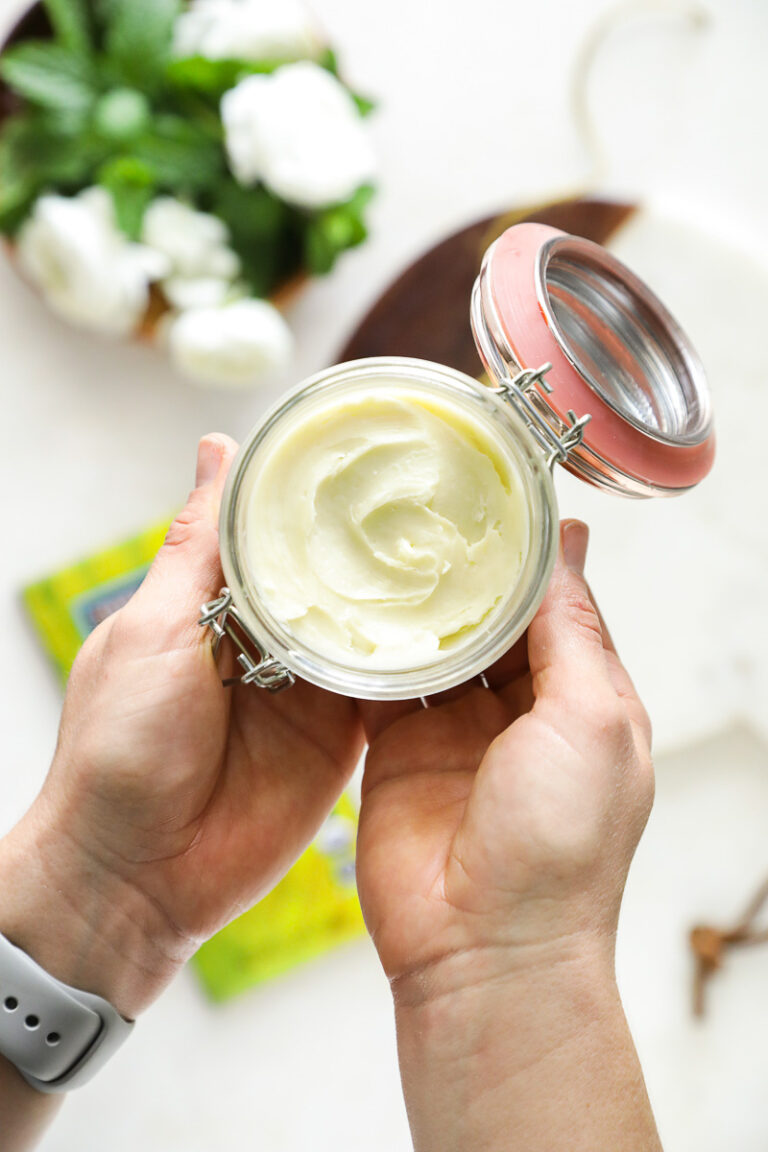
I’ll guide you, step-by-step, through how to make shea butter lotion, using shea butter and no coconut oil (because coconut oil can and will clog pores). The final product is a non-greasy, 100% natural moisturizer, with a creamy consistency and skin-soothing properties.
This recipe is used just like store-bought body lotions: to moisturize the face, hands, feet, legs, arms. Technically, this is more of a homemade body butter recipe: a thick moisturizing cream versus a pumpable lotion. (Make pumpable lotion recipe here.)
But whatever you call it, it’s one thing: AMAZING!
What is Shea Butter?
Shea butter comes from the “nut” (or pit) of the fruit found on the Karite Tree. It is soft, compared to cocoa butter, and has a strong scent when it’s purchased in an unrefined state.
I use unrefined shea butter in body-care recipes, but if you don’t care for the (natural) fragrance, I recommend using refined shea butter. Shea butter softens and moisturizes the skin, making it perfect for homemade lotion, shaving cream, and lip balm.
Benefits of Shea Butter
Shea butter is the main ingredient used to make homemade body lotion and many other skin care products.
- It’s naturally rich in vitamins and fatty acids, like vitamin A and vitamin E.
- It contains anti-inflammatory, antibacterial, and antioxidant properties. It’s ideal for sensitive skin and as an anti-aging product. There’s even evidence that shea butter could help with wrinkles.
- Shea butter helps to combat dry skin. It’s an emollient: traps moisture on the skin without clogging pores. There’s also some evidence to suggest that it may help to alleviate eczema symptoms and soften scar tissue. Source: Medical News Today
- Shea butter contains stearic acid, a naturally occurring fatty acid, that allows the butter to spread smoothly on skin without tension. This makes it ideal for a body and face moisturizer since it will melt right into the skin!
I personally use shea butter moisturizer every night before bed. And I’ve seen the texture and softness of my skin improve.
Before You Get Started: Ingredients & Tools
The natural ingredients can be found at most health food stores or online via Amazon. Each ingredient is carefully chosen for its natural moisturizing properties.
Video Recipe Tutorial
How to Make Shea Butter Lotion: Step-By-Step Instructions
Here’s the best way to make shea butter lotion, step by step.
Step 1: Melt Shea Butter
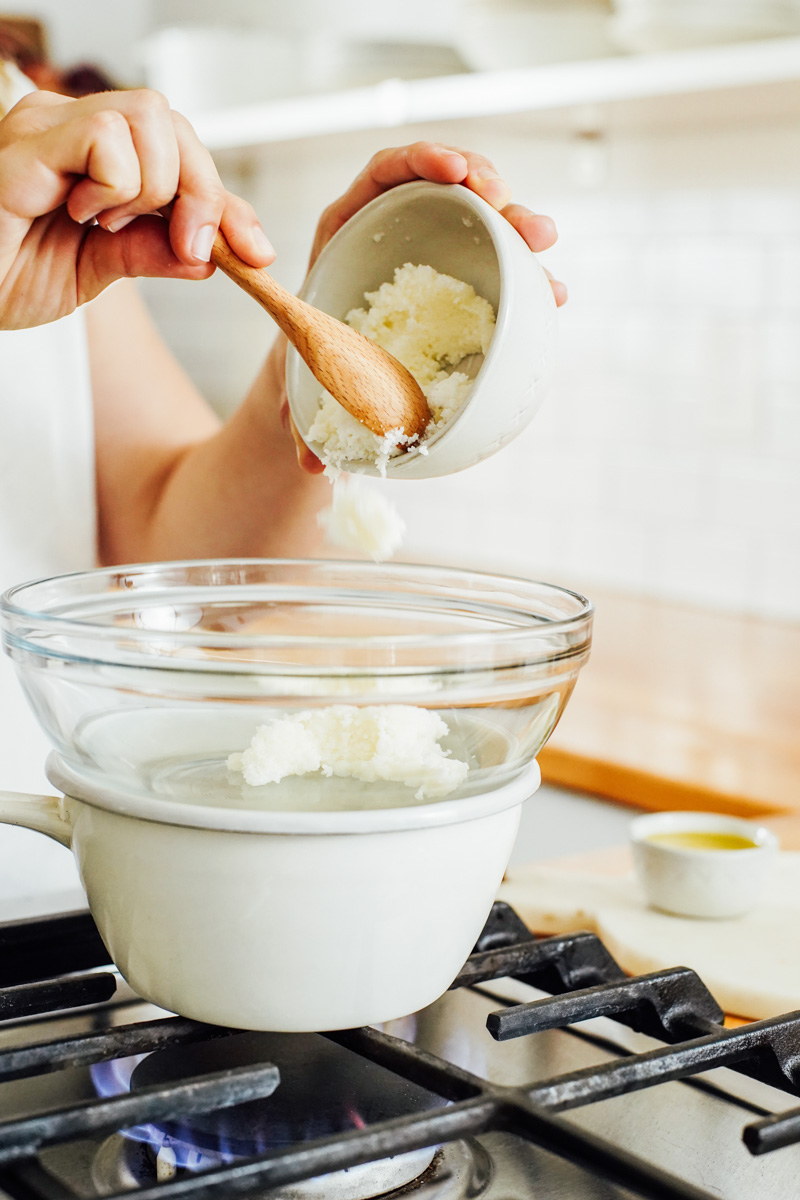
Heat the shea butter to melt it, don’t burn it. To avoid burning the shea butter, create a DIY double boiler. This will allow you to melt the shea butter without it directly touching the heat.
Place a medium-size glass bowl over a sauce pan filled 1/4 the way full with water. The glass bowl should sit just on top of the saucepan, without touching the water in the pan.
Over medium heat, allow the water in the saucepan to simmer. Then add the shea butter and melt.
Once the shea butter has fully melted (about 2-3 minutes), turn off the heat and remove the bowl from the heat.
Step 2: Add Nourishing Carrier Oil
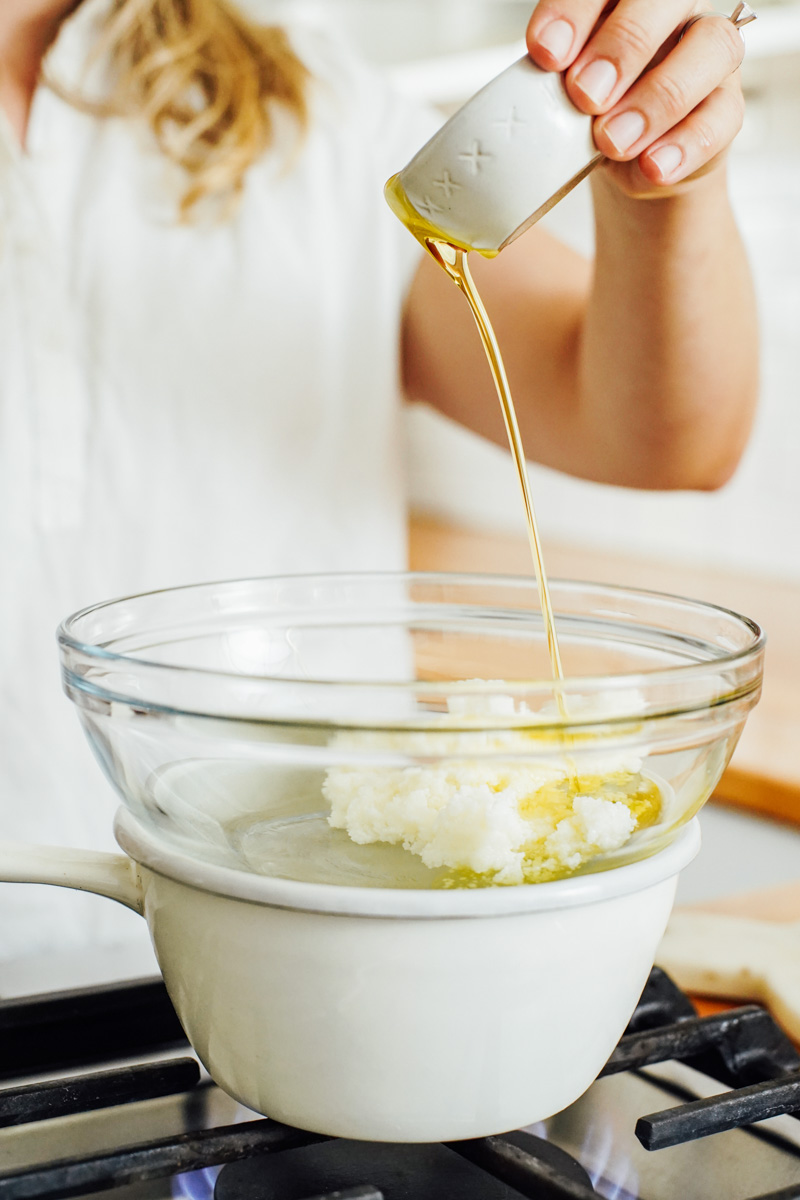
Stir 1 teaspoon of arrowroot starch into the liquid oil of choice (grapeseed oil, sweet almond oil, OR jojoba oil) and whisk to combine. Pour the oil (and arrowroot starch whisked in, if using) into the shea butter.
You can skip the arrowroot starch and add the oil directly to the shea butter at this step. The arrowroot creates a non-greasy lotion.
How do you make non-greasy shea butter lotion? Adding arrowroot starch, which is similar to cornstarch, is the best option. You’ll find this ingredient in the baking section at most grocery stores or online. This ingredient may also be used in cooking: make almond flour cookies and waffles or thicken stir-fry sauce.
Step 3: Cool in the Fridge
At this point, the shea butter and oil mixture should be cooler (along with the bowl).
If not, allow it to rest for a few minutes. Then place the mixture in the fridge and allow it to solidify (about 30 minutes to 1 hour, depending on location in the fridge and temperature).
Alternatively, speed up the process by placing the bowl in the freezer.
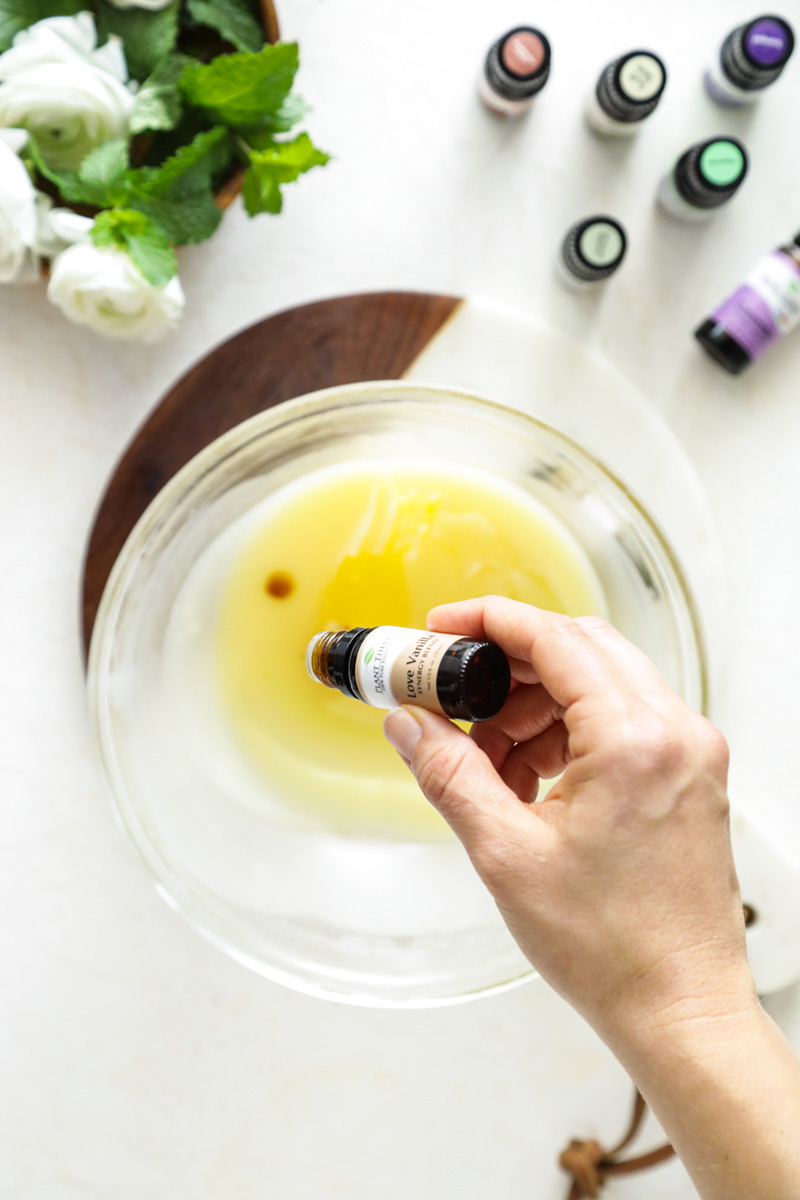
Step 4: Add Essential Oils
Once the mixture is opaque and firm (not solid as a rock), remove the bowl from the fridge.
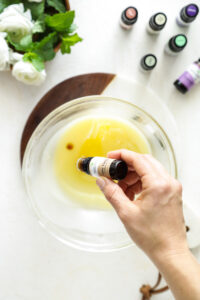
Add the essential oil (or a combination of essential oils) of choice, if desired. Add up to 15 drops of skin-safe essential oils to this mixture. A few of my favorite essential oils to add are listed in the recipe below.
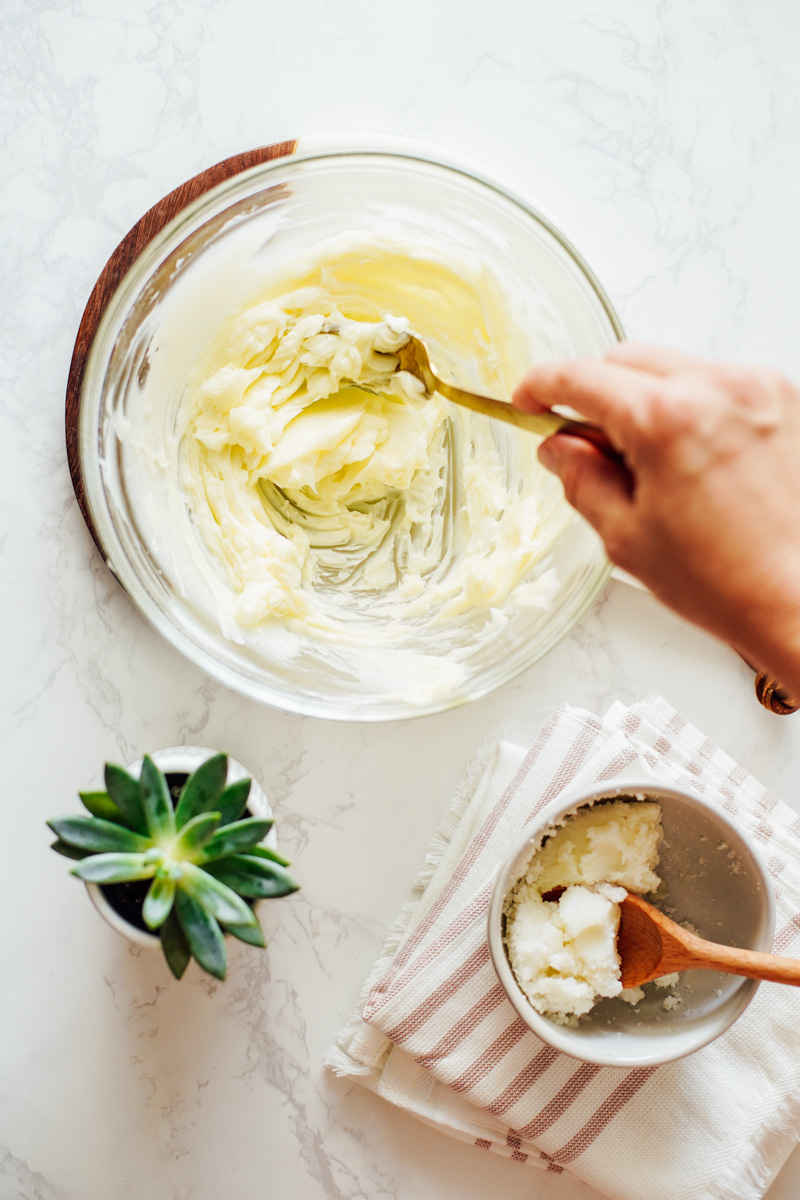
Step 5: Whip the Shea Butter
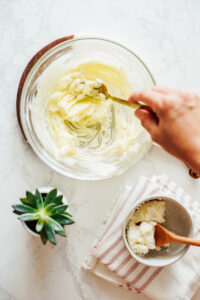
Use the whisk attachment and an electric mixer, hand mixer, or a fork to whisk the mixture until it appears “whipped.” This doesn’t take very long, just a few seconds using a mixer and a bit longer with a fork.
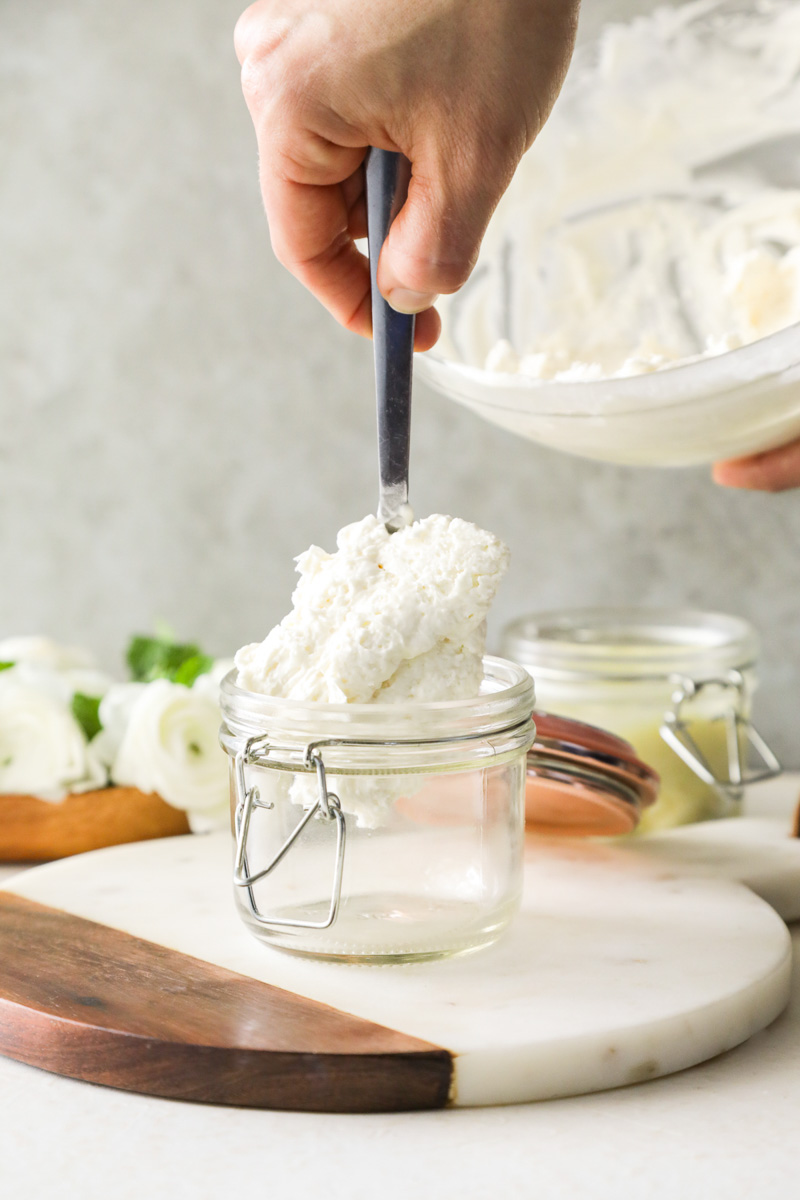
Step 6: Spoon Lotion into a Jar
Now you get to enjoy this amazing homemade lotion recipe and all its benefits (we’ll talk about the awesome benefits in a minute). Or, share the lotion as a gift.
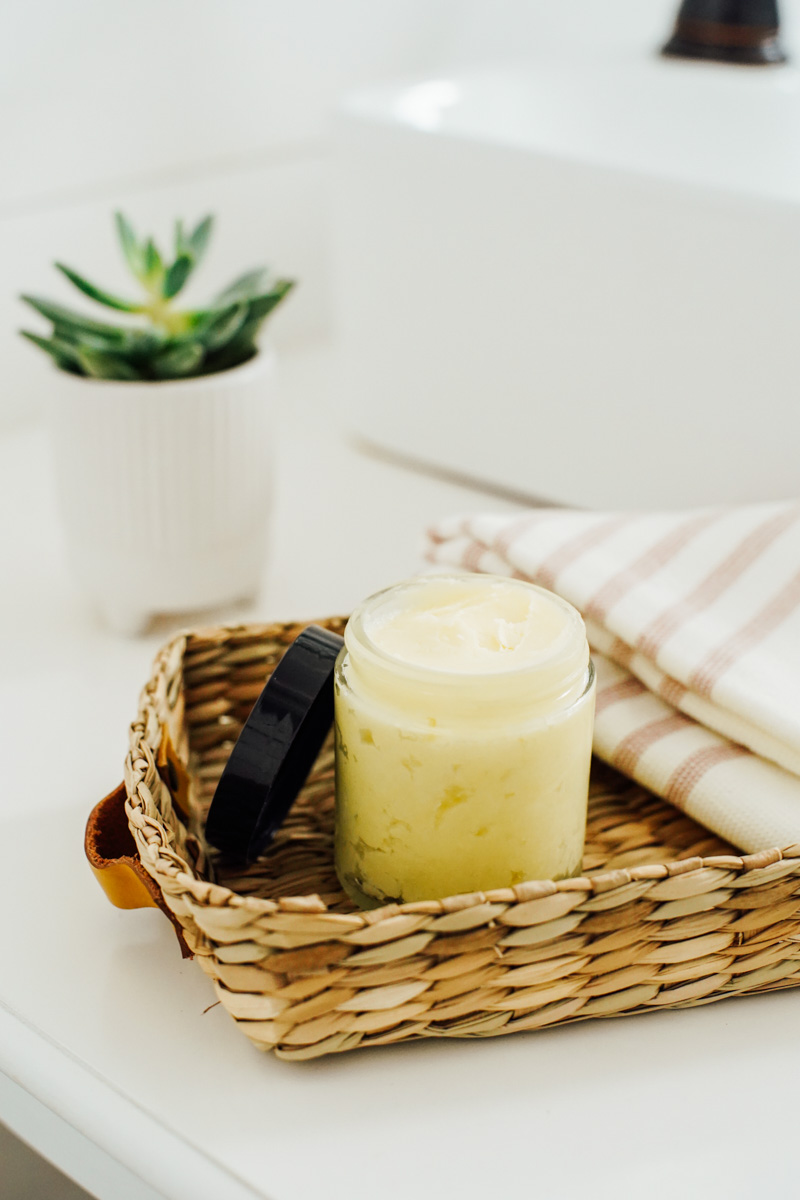
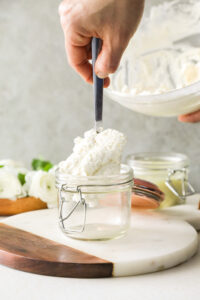
Choose a beautiful glass jar and spoon your creation into the jar. Add a label, if desired. And store the lotion at room temperature in a cool place (like a bathroom cabinet) for up to 6 months.
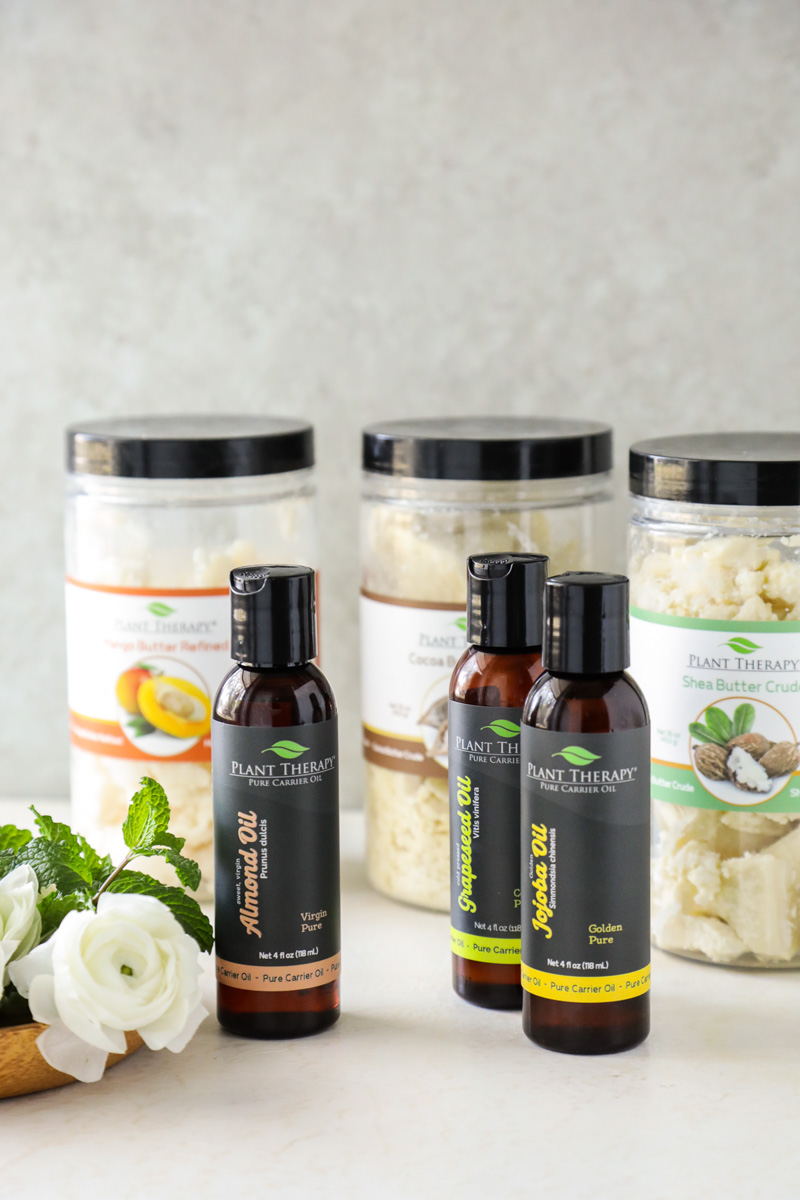
How to Choose a Carrier Oil
You can use shea butter alone as a body and face moisturizer, or you can mix it with a carrier oil to make a whipped body butter recipe or lotion (like this recipe).
Here’s what I recommend for a nourishing carrier oil to mix with the shea butter. The options absorb easily in the skin, making them the best options for a non-greasy lotion.
Jojoba Oil: Jojoba oil is made from a shrub that grows in Northern Mexico and the Southeast US. Jojoba is an emollient: a natural moisturizer that softens and moisturizes skin. Jojoba is the closest to our skin’s natural oil, making it ideal for all skin types.
Grapeseed Oil: This oil comes from pressed grape seeds. It has high amounts of fatty acids, vitamin E, and antibacterial properties. Grapeseed oil may be a great option for aging skin and for those with acne-prone skin.
Sweet Almond Oil: Made from sweet almonds and rich in vitamin A & E, fatty acids, and proteins.
Virgin Coconut oil is also an option, but as I’ll share in a minute, I don’t care for using coconut oil on my face. If you’re just using this lotion on your body, coconut oil may be a good option.
How to Use
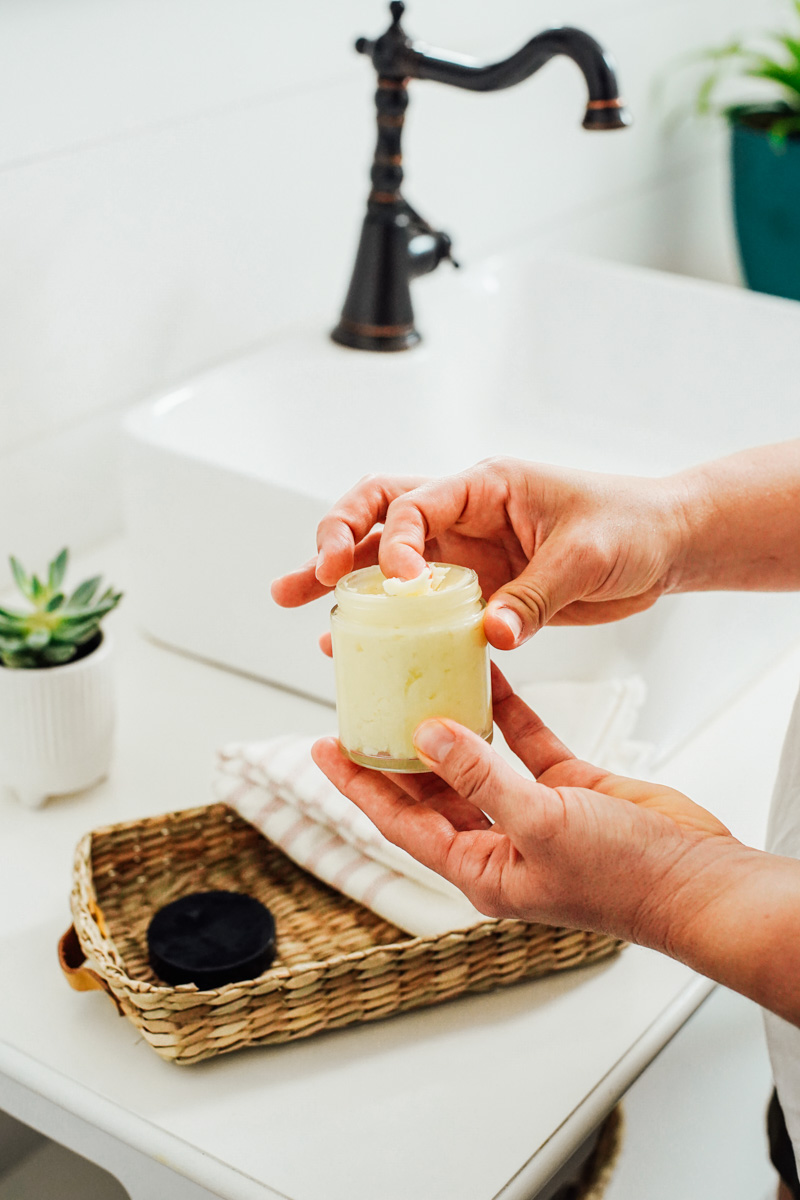
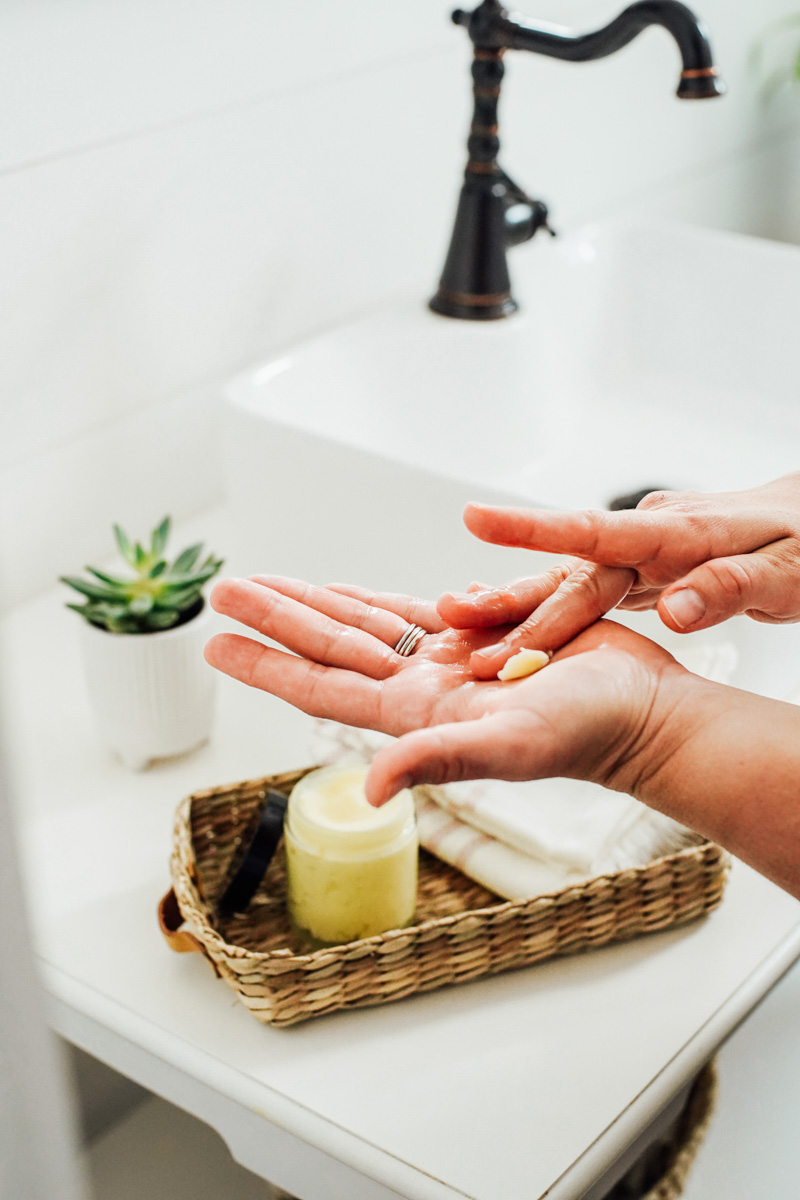
Scoop a small amount of shea butter lotion out of the jar using your finger, then rub between your hands. The heat from your hands will soften the shea butter. Massage into your skin: face, arms, legs, feet, dry patches, etc.
A little goes a long way.
For the face, apply this moisturizer after cleansing (my favorite natural face cleansers) and toning (a spritz of rose water is my favorite). If you use any serums, apply a facial serum before applying the lotion.
What’s the Shelf Life?
This natural lotion recipe doesn’t use any preservatives. Store-bought lotions add preservatives to formulas out of necessity. Without a preservative, mold and other bacteria will grow in a water-based lotion.
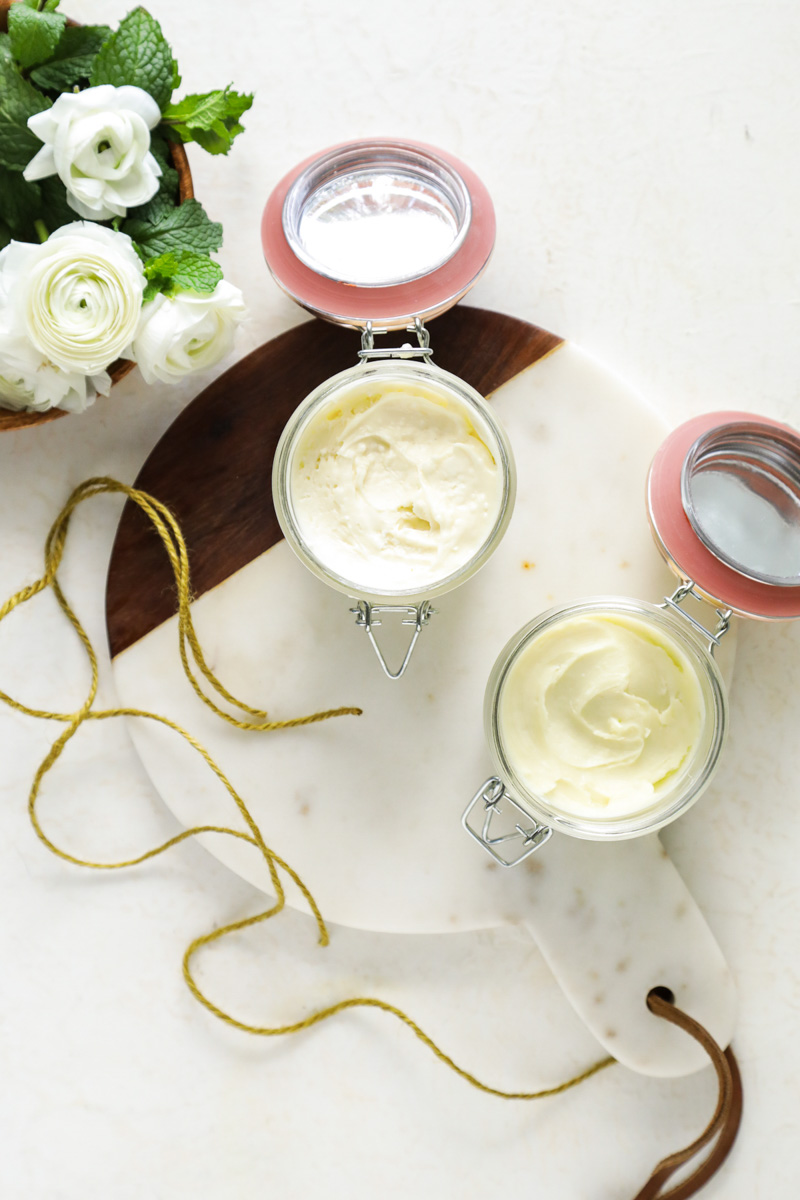
This recipe doesn’t need a preservative because it doesn’t use water in the formula. This means you can make a long lasting moisturizing lotion, without using any preservatives and don’t need to worry about mold growth. Woohoo!
Store the final product at room temperature, in a cool dry place, for up to 6 months. I recommend keeping homemade shea butter lotion away from heat, like a hot steamy shower, since it will melt slightly. This recipe is intended for home use; not to be sold commercially.
How to Add Essential Oils
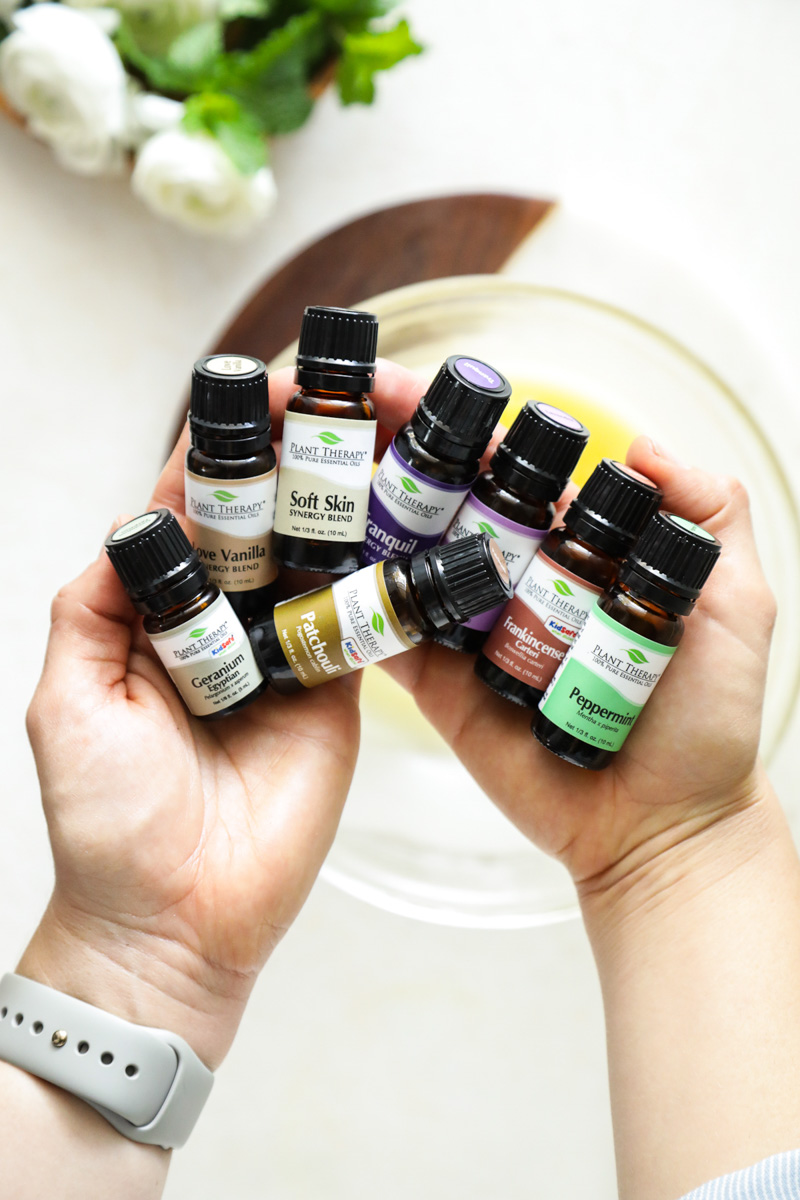
If you want to scent your own lotion, essential oils are the best way to do this! Along with their scent, essential oils are easily absorbed by the skin for nourishment, and provide antibacterial and soothing properties.
Add one essential oil or a combination of essential oils, totally 15 drops, to this lotion recipe. The best essential oils for homemade lotion are…
- Roman Chamomile
- Frankincense
- Lavender
- Rosemary
- Jasmine
- Carrot Seed
- Rose
- Lavender
- Tea tree
- Sandalwood
- Geranium
Essential Oils to Avoid: Avoid citrus essential oils (like lemon or orange essential oil) if you plan to wear this lotion during the day when exposed to the sun. Citrus essential oils are photosensitive and can cause your skin to develop a rash or sunburn.
Lotion Without Coconut Oil, Here’s Why
You’ll notice that this recipe doesn’t use any coconut oil. A lot of lotion and homemade whipped body butter recipes rely heavily on coconut oil.
Coconut oil is not the cure-all. Gasp, I know. That statement is practically heresy in the natural living community. Toothpaste? Coconut oil. Smoothies? Yep, coconut oil. A boo-boo? More coconut oil. We use it for everything! I’ve learned the magical oil isn’t always suitable for every need.
Many years ago, I decided it was time to ditch the toxins found in our bathroom. From lotions to body wash to makeup, the amounts of toxins I put on my body was astounding. With the urge for simplicity and natural living, I started developing my own replacements for things like foundation powder and lotion.
One of my very first DIYs was a simple homemade moisturizer using coconut oil. After a few weeks of using this moisturizer on my face, I experienced multiple break outs, daily peeling, and dry skin patches. Here’s why…
There’s nothing wrong with coconut oil, but from a skin care perspective, it’s not the best moisturizer option for the face. If you use it on your face, it’s likely to clog pores and cause breakouts due to its chemical composition.
Shea butter does not clog pores and is the best moisturizer option. So skip the coconut oil on your face and instead turn to shea butter and a non-clogging carrier oil!

FAQs
6 More Ways to Use Shea Butter
- Use shea butter to make homemade deodorant. You’ll also need arrowroot starch for homemade deodorant.
- Combine shea butter, coconut oil, and castile soap to make homemade moisturizing shaving cream.
- Combine butter, carrier oil, and beeswax to make Shea Butter Lip Balm or a custom DIY Lip Balm.
- Jojoba oil, coconut oil, shea butter, and soothing herbs come together to create DIY lotion bars.
- Shea butter, aloe vera, chamomile, and coconut oil make a fantastic homemade diaper rash cream.
- Use shea butter combined with mango butter and cocoa butter to make a customized body butter.
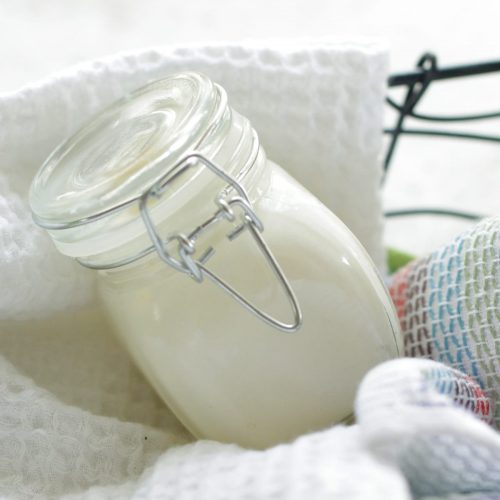
Homemade Moisturizing Shea Butter Lotion Recipe (Without Coconut Oil)
Equipment
- 1 electric mixer or fork
- 1 medium-size heat safe bowl
- 1 medium-size sauce pan
- 1 4-ounce glass storage jar (or larger)
Ingredients
- 1/2 cup shea butter (4 ounces)
- 1 teaspoon arrowroot flour starch (optional, to make a non-greasy lotion)
- 2 tablespoons nourishing carrier oil such as: jojoba, sweet almond oil, or grapeseed oil. This can even be coconut oil or olive oil (if not using on the face).
- 5 drops lavender essential oil optional*
- 5 drops rosemary essential oil optional*
- 3 drops carrot seed essential oil optional*
- 2 drops tea tree essential oil optional*
Instructions
Step 1: Melt Shea Butter
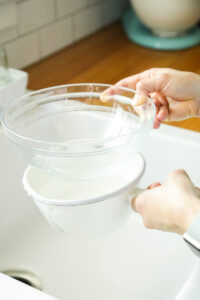
- To melt the shea butter, make a DIY double boiler. This will allow you to melt the shea butter without it directly touching the heat.
- Place a medium-size glass bowl over a sauce pan filled 1/4 the way full with water. The glass bowl should sit just on top of the saucepan, without touching the water in the pan.

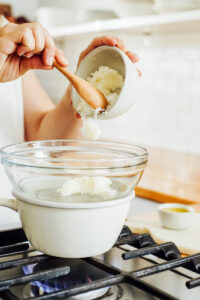
- Over medium heat, allow the water in the saucepan to simmer. Then add the shea butter and melt.
- Once the shea butter has fully melted (about 2-3 minutes), turn off the heat and remove the bowl from the heat.
Step 2: Add Nourishing Carrier Oil
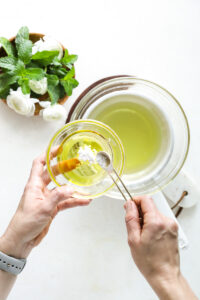
- Stir 1 teaspoon of arrowroot starch into the liquid oil of choice (grapeseed oil, sweet almond oil, OR jojoba oil) and whisk to combine. Pour the oil (and arrowroot starch whisked in, if using) into the shea butter.
- NOTE: You can skip the arrowroot starch and add the oil directly to the shea butter at this step. The arrowroot creates a non-greasy lotion.
Step 3: Cool
- At this point, the shea butter and oil mixture should be cooler (along with the bowl). If not, allow it to rest for a few minutes.
- Place the mixture in the fridge and allow it to solidify (about 30 minutes to 1 hour, depending on location in the fridge and temperature). Alternatively, speed up the process by placing the bowl in the freezer.
Step 4: Add Essential Oils
- Once the mixture is opaque and firm (not solid as a rock), remove the bowl from the fridge.
- Add the essential oil (or a combination of essential oils) of choice, if desired. Add up to 15 drops of skin-safe essential oils to this mixture. A few of my favorite essential oils to add are listed in the recipe above. You can add your favorite essential oil or oils, not the ones listed above (if desired).
Step 5: Whip
- Use the whisk attachment and an electric mixer, hand mixer, or a fork to whisk the mixture until it appears "whipped." This doesn't take very long, just a few seconds using a mixer and a bit longer with a fork.
Step 6: Store
- Choose a beautiful glass jar (4 ounces or larger) and spoon your creation into the jar. Add a label, if desired. And store the lotion at room temperature in a cool place (like a bathroom cabinet) for up to 6 months.
Video
Notes
- Roman Chamomile
- Frankincense
- Lavender
- Rosemary
- Jasmine
- Carrot Seed
- Rose
- Lavender
- Tea tree
- Sandalwood
- Geranium
Natural Body-Care Simplified
Learn how to make your own body and beauty products with simple ingredients.

Thank you for this recipe! Coconut oil is great for skin but not for the face because it does clog pores (NakedTruthBeauty). Shea butter with Jojoba is really great and does not clog whatsoever! Argan oil is also good since it is a “dry oil” and will soak in quickly. I will be making this tonight since I just found a Mother’s Cupboard store near my workplace!
Wonderful, Ashlynn. Enjoy! Argan oil is a great oil to use in this recipe.
Hello Kristin Marr
I have also just found this site while looking for a DIY Lotion to make and this one seams to be just right. I have only one question about the measurements.
You mentioned 2 TB skin-nourishing oil, is that 2 Table Spoons??? I am more familiar with metric measurements. I like your site and the way you get back to people to answer their questions. My compliments!
Hey Susanna, Thank you. The TB stands for tablespoons. 🙂 Let me know if you have any more questions.
Has anyone ever mentioned a peanut like scent to the shea butter? I made this recipe and the only thing that I can say is that’s the first thing I notice and it turns me off. I put lavender and frankincense oils, but they seem to be masked by this strong peanut odor. Any suggestions?
Hey Jesse, May I ask what kind of shea butter (brand) you used? I’ve never had a strong peanut-like odor with this lotion.
Oh yay! I am so excited to have a different variety of natural lotion to try! I really dislike the way coconut oil feels on my fingers, so I gave up on handmade lotions. I don’t have much time to make things from scratch, but I am trying to do better! Can’t wait to give this a shot! Thanks!
Awesome, Heather! Let me know what you think. You can also double this recipe (or even triple) if you like it.
I just found your site, and can’t wait to try this.
I, too, would love to find the beautiful jars you used. I tried the Amazon link in one of your comments above, but it took me to Bell quilted jars, which are not nearly as cute. Could you tell me who manufactured the jars? It might be marked on the lid.
Thanks!
Hey Karen, The jar in the picture doesn’t have a name. I bought a bunch in the dollar section at Target a few months ago. Online this jar is the closet thing I can find to the jar pictured.
Hi Kristin, I just made this lotion and it is more yellowish in color, is that okay? Can i melt the lotion again and add more lavander oil or vanilla oil because i am not liking the smell of the tea tree oil. Thank you.
Hey Lea, The color of the lotion will vary with shea butter. The shea butter I now use (listed above) is more yellow as it’s unrefined. So a yellow color is perfectly normal :). You can add more lavender directly to the whipped lotion as it’s probably still soft and can be stirred into the lotion. You can also melt the mixture back down, just make sure it’s over a low heat to protect the EOs.
If I use kokum or mango butter instead of shea will I need that many drops of EO? I know shea has a stronger smell than two mentioned above.
Hey Sarah, The oil amounts are more for skin benefits than aroma, but you can reduce the amounts and still create a great lotion product. I’ve never tried kokum or mango butter in this recipe, so I’m not sure how those would effect the lotion’s scent. Let me know how it goes.
Kristin,
A big thanks to you for this wonderful recipe. This is my second DIY try and its absolutely fantastic. My skin drinks this lotion! Even though my skin is super dry, I find this lotion too greasy on the face. Would you please suggest any variation that would work on face too?
Hey Swetha, Thank you. I’m so glad you like the lotion. I would suggest trying a different nourishing oil if the lotion is too oily for your face. Something light like argan, tamanu, or jojoba may work. You could even just mix the nourishing oils together such as Crunchy Betty’s recipe calls for: http://www.crunchybetty.com/simple-homemade-3-ingredient-facial-oil-moisturizer-customize-it-for-your-own-gorgeous-skin.
Meadowfoam seed oil is one of the least pore-clogging and lightest of the oils out there. You could give that one a try.
Awesome, Teresa! Thanks for sharing!
Hello !
I just found your website while looking for a moisturizing lotion recipe for my 6 years old daughter and myself . Would this one work on a child ? (I would use it as a body lotion for her, not on her face)
Also would it work without essential oils ? My daughter has asthma and our pediatrician recommended to stay away from essential oils for now 🙂
thank you !
Hey Margaux, This lotion is perfect for an adult and child. My daughter (2) likes to put some on after bath time just like mommy. You can leave the essential oils out and still create a wonderful lotion. The essential oils are added for their skin benefits, but the oil and shea work on the moisturizing.
I wonder if your pediatrician is confusing true essential oils with “fragrances” used in perfumes. There are several essential oils that are indicated for asthma (much backed up by scientific research).
Helichrysum (pretty much any of the species, except Helichrysum splendidum) is rich in 1,8 cineole (also known as eucalyptol) on which there is a great deal of research backing up the following theraputic properties: expectorant, mucolytic, mucociliary, antitussive, bronchodilator, and anti-inflammatory (it’s actually an ingredient commonly found in many products that are indicated for all sorts of respiratory conditions)
Other oils rich in cineole are Eucalyptus (globulus and radiata – radiata more for children) and Rosemary (ct. cineole). I’m sure you’ve heard of Eucalyptus. It’s pretty much everywhere.
Clary Sage (Salvia sclarea) is rich in linalyl acetate, known for its antispasmodic properties (can help relieve the spasmodic coughing associated with asthma) as well as for easing the tension and anxiety due to the attack. Linalool (another key constituant) is known for its anti-inflammatory properties (as is linalyl acetate). The two combined can pack a theraputic punch against inflammation of the airway.
There are other oils rich components that have some serious scientific backing that are beneficial to those suffering from asthma.
Before completely dismissing essential oils, I would seek out and consult with a certified aromatherapist in your area. She or he will know the safest and most effective oils and their concentrations as well as methods of application (inhalers, et. al.) If that consultation proves hopeful, let her pediatrician know of your intentions. The aromatherapist and physician should both be aware of what the other is using in case of contraindications between physician-prescribed medications and what the aromatherapist suggests.
Regardless of what path(s) you choose to follow, I wish you the best of luck with your daughter.
Kristen, I just made my first batch of Lotion w/o Coconut Oil. I am in heaven! After putting the finished product in the glass jar, I took the Kitchen Aid bowl and whisk up to my shower, showered and got every last dab out of the bowl onto my body. Oversharing I may be, but I’ve been stroking my skin all afternoon! I used Lavender, Rose~Geranium and Orange Oils, skipping the Rosemary and Tea Tree. What an incredible recipe. Thank you so much for sharing this with us dried out beauties.
Woohoo, Dorothy! I’m so glad you love the lotion so much!! I love your oil combo, I’m going to have to try that combo next time.
Can you share a link for the container you used? Thanks!!
Hey Randeep Dhanota, I bought my container in Target’s dollar section last year, but this is something similar: http://amzn.to/1CsTrZ7.
Thank you Kristen. I am ready to go try this! Well. . . on Monday. After a week of house guests, I’m flat on my couch right now!
And is the lavender for the aromatics primarily? Would rose~geranium work instead? Thank ye kindly, Kristen.
Hey Dorothy, The lavender provides a healing touch among a few other properties, but you can use rose-geranium instead.
Hi Kristin,
I thought I had posted my question but can’t find it here, so I’ll try again. I don’t know how blogs work! Anyway, I cannot stand the smell of tea tree oil, ‘tho a bit in the cleaning stuff I tolerate, just because the whole formula works so well! But having that aroma, even the small amount it calls for, in my body lotion, ain’t gonna fly. So, my questions are:
1) What is the purpose of the tea tree oil?
2) Is it essential for the effectiveness of the lotion?
Thank you so much. I’m loving the recipes I have made: laundry detergent, surface cleaner, astringent and facial cleansing oil.
Dorothy
Hey Dorothy,
I received your message this time. Yay!!
Tea tree does have an interesting smell. You can definitely leave it out in this recipe. It does add benefit for the skin, but leaving it out will still create a wonderful lotion. I wouldn’t replace it with a a different, although you could up the lavender amount just to compensate, if desired.
And is the lavender for the aromatics primarily? Would rose~geranium work instead? Thank ye kindly, Kristen.
Hi All! I left out the tea tree oil bc I didn’t have and used a few drops of lemon EO instead (I read it has a similar antibacterial affect) so figured I’d try it. Also, I didn’t have lavender on hand so my lotion does have more of a shea butter smell. I also added some vitamin E oil and some rosehip oil . I love it, thanks so much!! At first I thought I missed something bc my lotion hardened but read another comment and was relieved. Thought it would be creamier but still very nice. May add more oil next time around. Great lotion.
Awesome, Kathryn! I’m so glad you like it. Yes, it’s a bit harder than the creamy lotions from the store (adding coconut oil is usually the solution many people use for making a soft, whipped homemade lotion), but hopefully it’s still spreadable :). Enjoy!!
Where did you get the jars that are pictured here? Thanks for the info and I can’t wait to try the lotion!
Hey Joanie, The jars pictured are small mason jars, like these: http://amzn.to/1qk7irO. I buy them online or at Target.
You can get them on the canning section at Wal-Mart, too.
Thank you Kristin
I love making it at home.. For a smoother lotion, use less and add more of a liquid oil like almond oil..
Is there a way to adapt this recipe to turn it into a whipped body butter? Do the essential oils act to keep the bacteria from colonizing in the lotion? I am new to making my own lotions. Thanks in advance for your reply.
Hey Nanette, I’ve tried creating a recipe that stays “whipped” and super fluffy without success. This lotion will be spreadable, but not whipped after sitting on the counter for a couple days. There’s no concern for bacteria growth because we aren’t adding any water to the recipe. The essential oils add beneficial properties for the skin. Hope that helps :).
Hello I was wondering in you Homemade moisturizing creme if I can use rose hip oil instead of carrot seed oil?
Hey Shelly, I think rose hip oil would be wonderful in place of the carrot seed.
Hi, ! kristin
I make the cream with shea butter,but is very hard.I can melt again ?
Thank you
Hi Roberta, If it’s too hard you can melt the oil and shea butter again and try whipping it. The lotion should be “hard” but spreadable.