
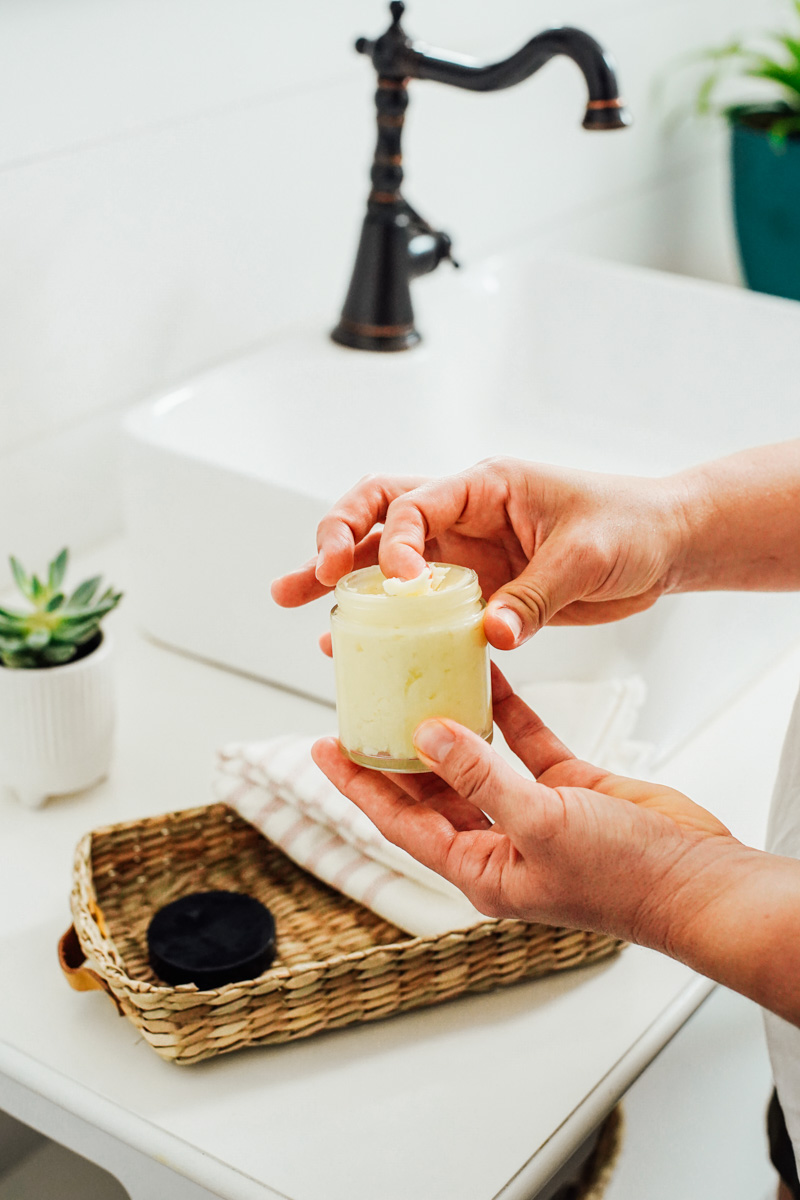
This simple DIY shea butter lotion recipe (made with just 3 ingredients) is the perfect moisturizer for the whole body, face included, and may be used for acne-prone and aging skin.
Want to Save This Article?
Enter your email & I’ll send it straight to your inbox. And you’ll get new recipes & tips each week.
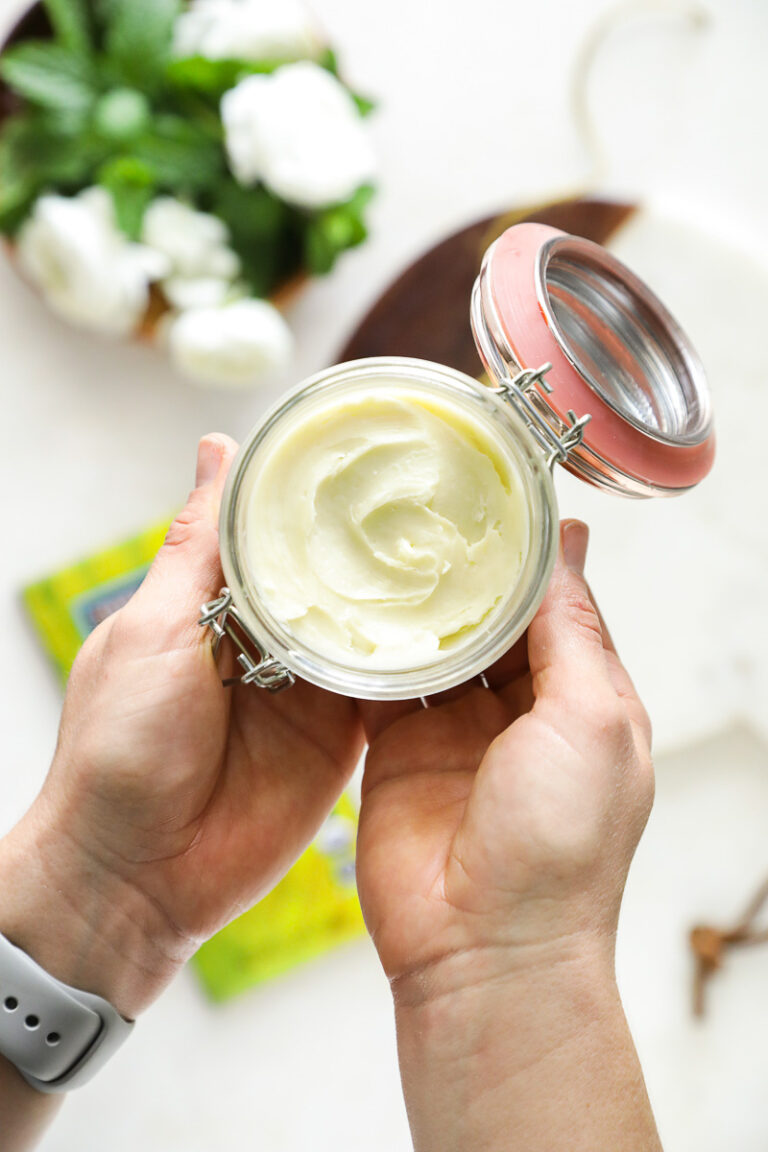
I’ll guide you, step-by-step, through how to make shea butter lotion, using shea butter and no coconut oil (because coconut oil can and will clog pores). The final product is a non-greasy, 100% natural moisturizer, with a creamy consistency and skin-soothing properties.
This recipe is used just like store-bought body lotions: to moisturize the face, hands, feet, legs, arms. Technically, this is more of a homemade body butter recipe: a thick moisturizing cream versus a pumpable lotion. (Make pumpable lotion recipe here.)
But whatever you call it, it’s one thing: AMAZING!
What is Shea Butter?
Shea butter comes from the “nut” (or pit) of the fruit found on the Karite Tree. It is soft, compared to cocoa butter, and has a strong scent when it’s purchased in an unrefined state.
I use unrefined shea butter in body-care recipes, but if you don’t care for the (natural) fragrance, I recommend using refined shea butter. Shea butter softens and moisturizes the skin, making it perfect for homemade lotion, shaving cream, and lip balm.
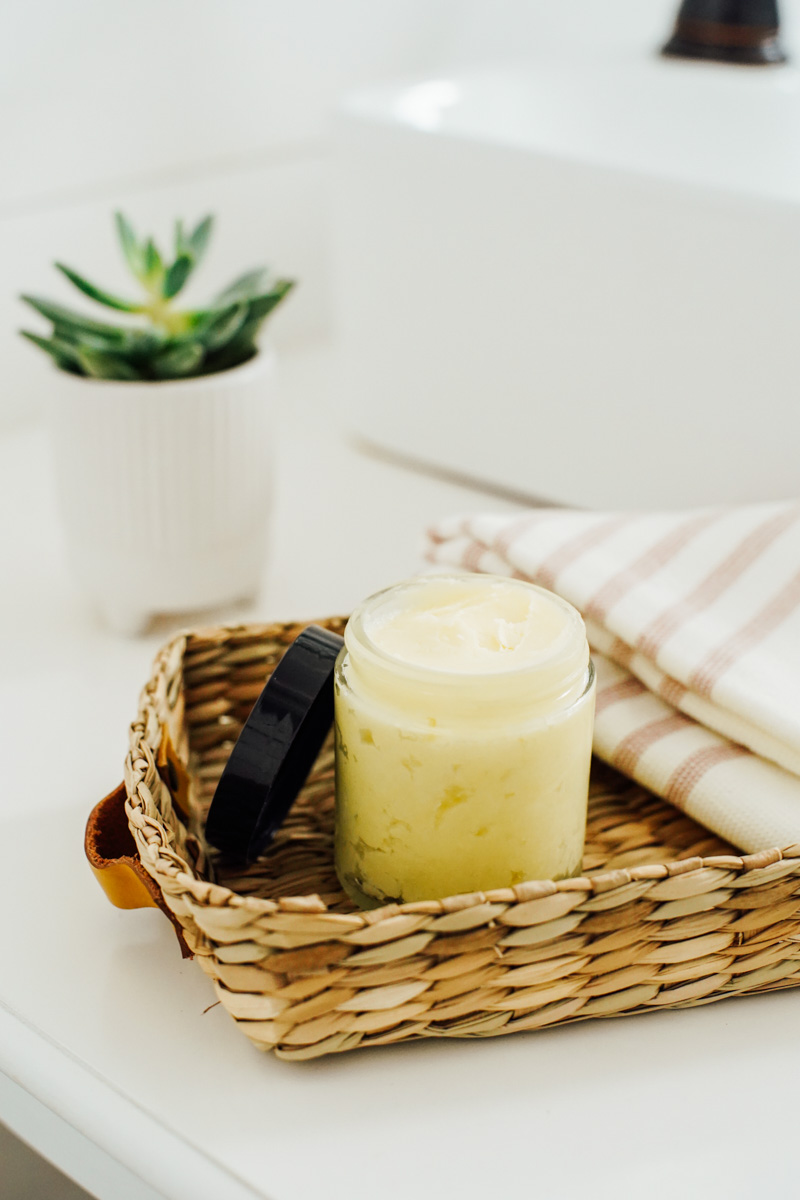
Benefits of Shea Butter
Shea butter is the main ingredient used to make homemade body lotion and many other skin care products.
- It’s naturally rich in vitamins and fatty acids, like vitamin A and vitamin E.
- It contains anti-inflammatory, antibacterial, and antioxidant properties. It’s ideal for sensitive skin and as an anti-aging product. There’s even evidence that shea butter could help with wrinkles.
- Shea butter helps to combat dry skin. It’s an emollient: traps moisture on the skin without clogging pores. There’s also some evidence to suggest that it may help to alleviate eczema symptoms and soften scar tissue. Source: Medical News Today
- Shea butter contains stearic acid, a naturally occurring fatty acid, that allows the butter to spread smoothly on skin without tension. This makes it ideal for a body and face moisturizer since it will melt right into the skin!
I personally use shea butter moisturizer every night before bed. And I’ve seen the texture and softness of my skin improve.
Before You Get Started: Ingredients & Tools
The natural ingredients can be found at most health food stores or online via Amazon. Each ingredient is carefully chosen for its natural moisturizing properties.
Video Recipe Tutorial
How to Make Shea Butter Lotion: Step-By-Step Instructions
Here’s the best way to make shea butter lotion, step by step.
Step 1: Melt Shea Butter
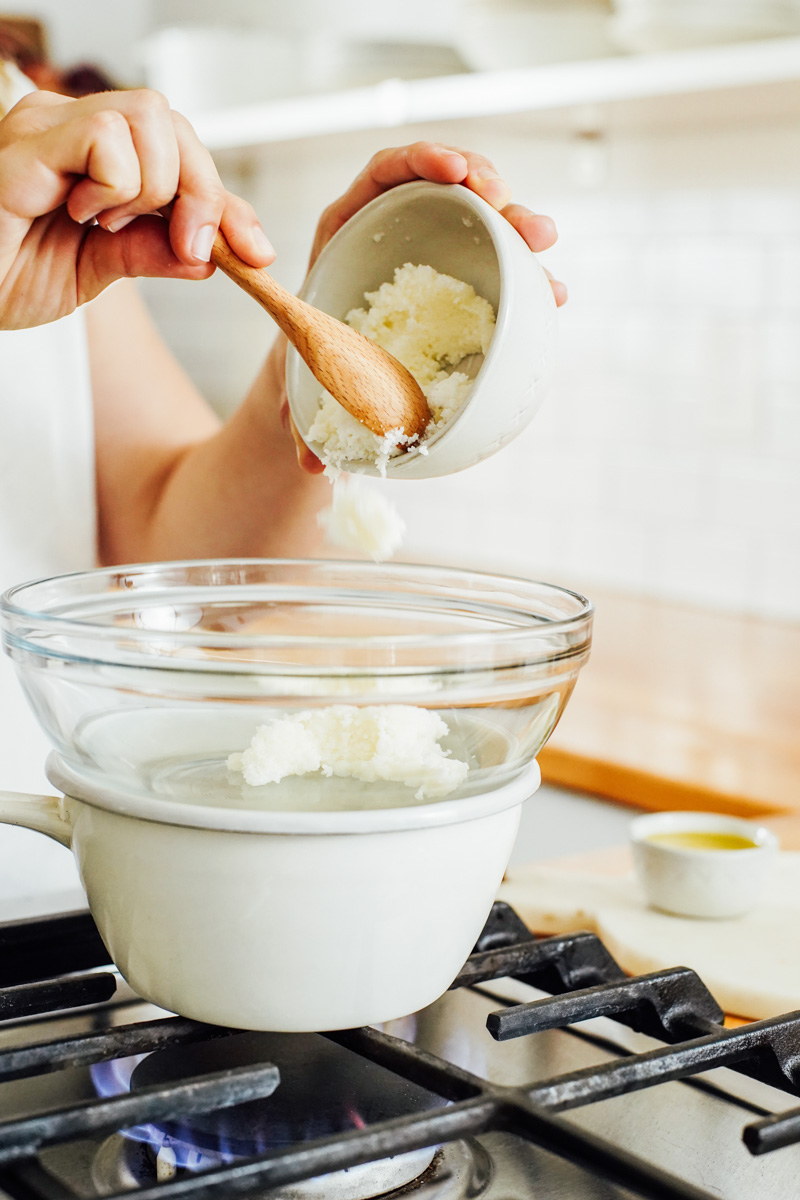
Heat the shea butter to melt it, don’t burn it. To avoid burning the shea butter, create a DIY double boiler. This will allow you to melt the shea butter without it directly touching the heat.
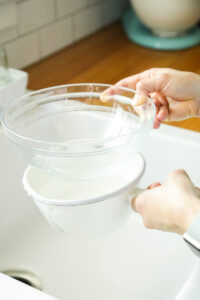
Place a medium-size glass bowl over a sauce pan filled 1/4 the way full with water. The glass bowl should sit just on top of the saucepan, without touching the water in the pan.
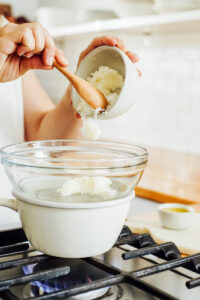
Over medium heat, allow the water in the saucepan to simmer. Then add the shea butter and melt.
Once the shea butter has fully melted (about 2-3 minutes), turn off the heat and remove the bowl from the heat.
Step 2: Add Nourishing Carrier Oil
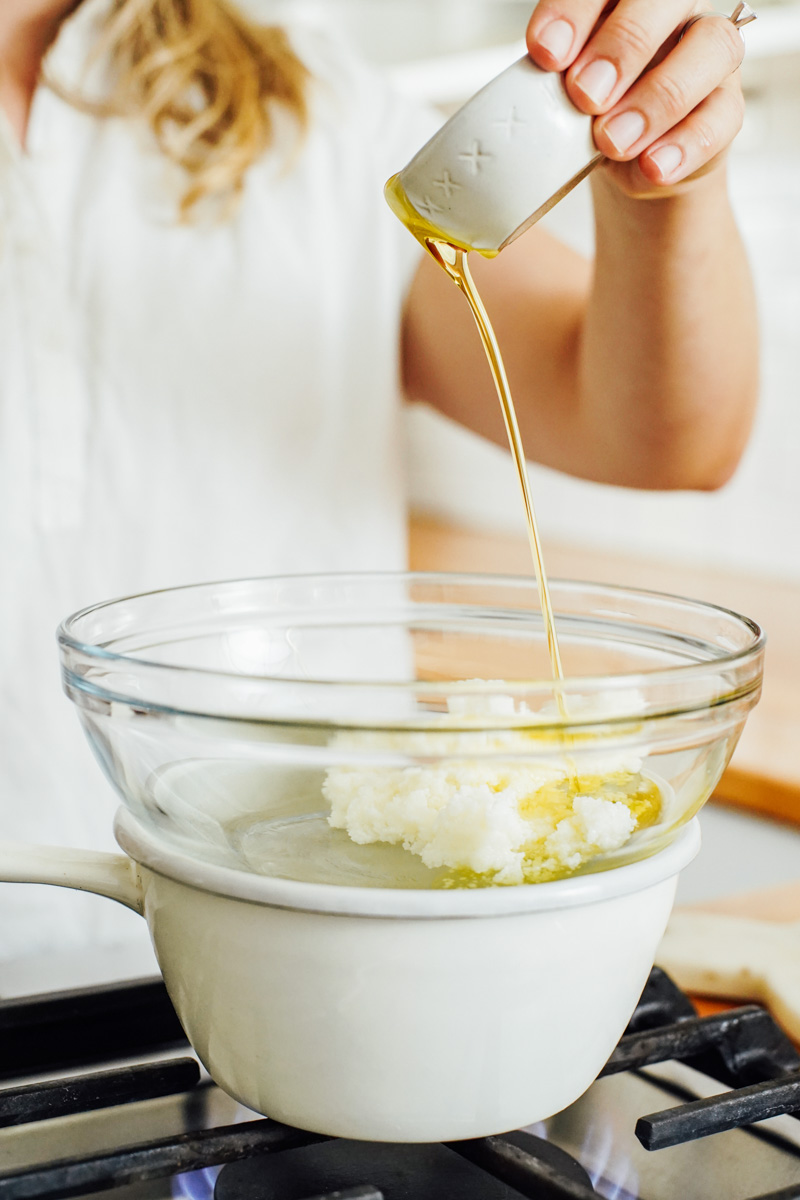
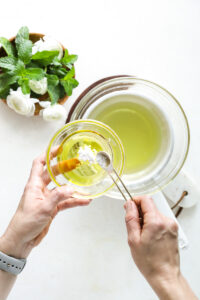
Stir 1 teaspoon of arrowroot starch into the liquid oil of choice (grapeseed oil, sweet almond oil, OR jojoba oil) and whisk to combine. Pour the oil (and arrowroot starch whisked in, if using) into the shea butter.
You can skip the arrowroot starch and add the oil directly to the shea butter at this step. The arrowroot creates a non-greasy lotion.
How do you make non-greasy shea butter lotion? Adding arrowroot starch, which is similar to cornstarch, is the best option. You’ll find this ingredient in the baking section at most grocery stores or online. This ingredient may also be used in cooking: make almond flour cookies and waffles or thicken stir-fry sauce.
Step 3: Cool in the Fridge
At this point, the shea butter and oil mixture should be cooler (along with the bowl).
If not, allow it to rest for a few minutes. Then place the mixture in the fridge and allow it to solidify (about 30 minutes to 1 hour, depending on location in the fridge and temperature).
Alternatively, speed up the process by placing the bowl in the freezer.
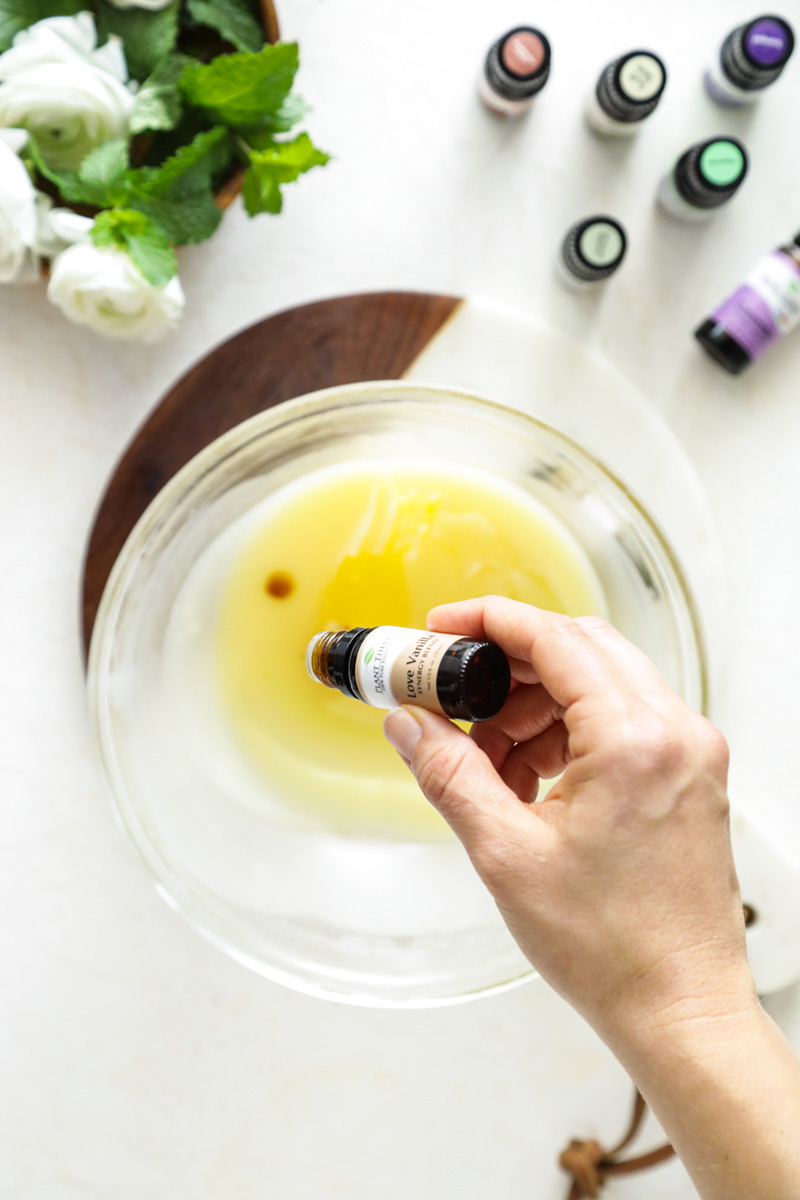
Step 4: Add Essential Oils
Once the mixture is opaque and firm (not solid as a rock), remove the bowl from the fridge.
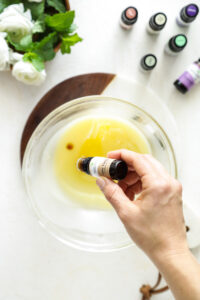
Add the essential oil (or a combination of essential oils) of choice, if desired. Add up to 15 drops of skin-safe essential oils to this mixture. A few of my favorite essential oils to add are listed in the recipe below.
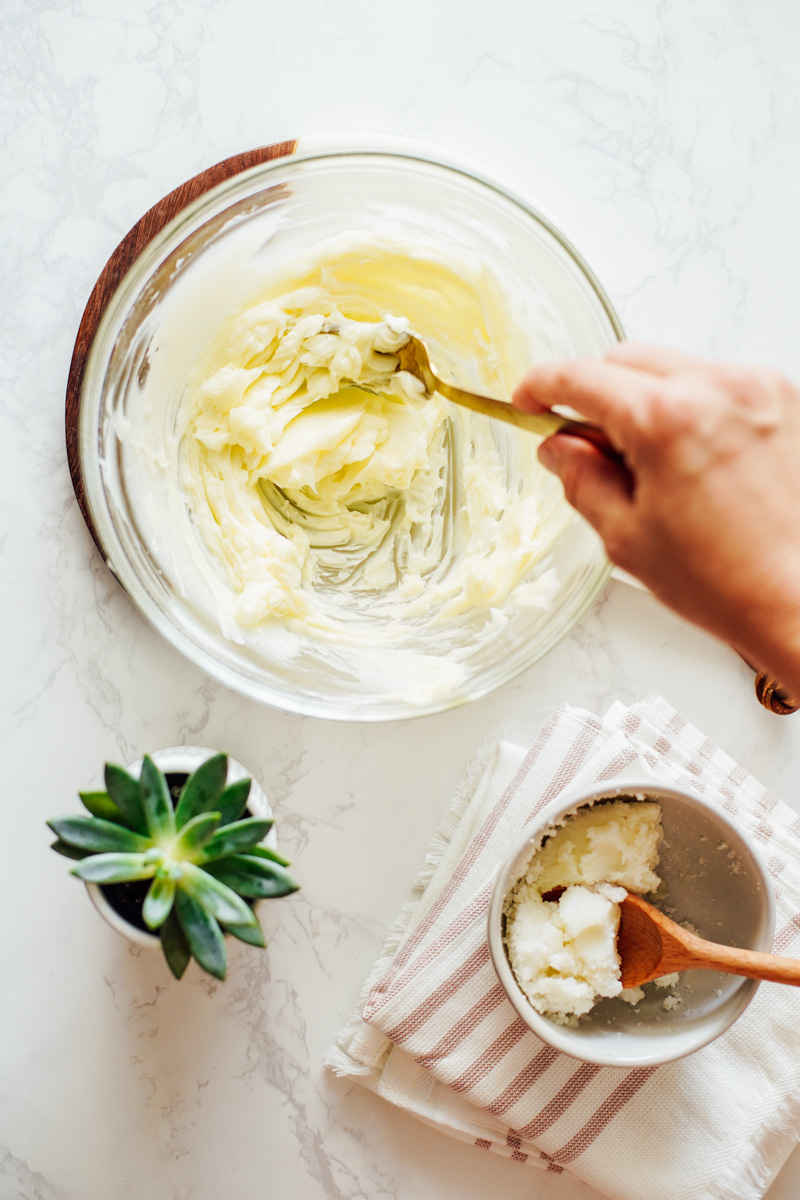
Step 5: Whip the Shea Butter
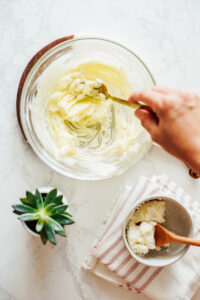
Use the whisk attachment and an electric mixer, hand mixer, or a fork to whisk the mixture until it appears “whipped.” This doesn’t take very long, just a few seconds using a mixer and a bit longer with a fork.
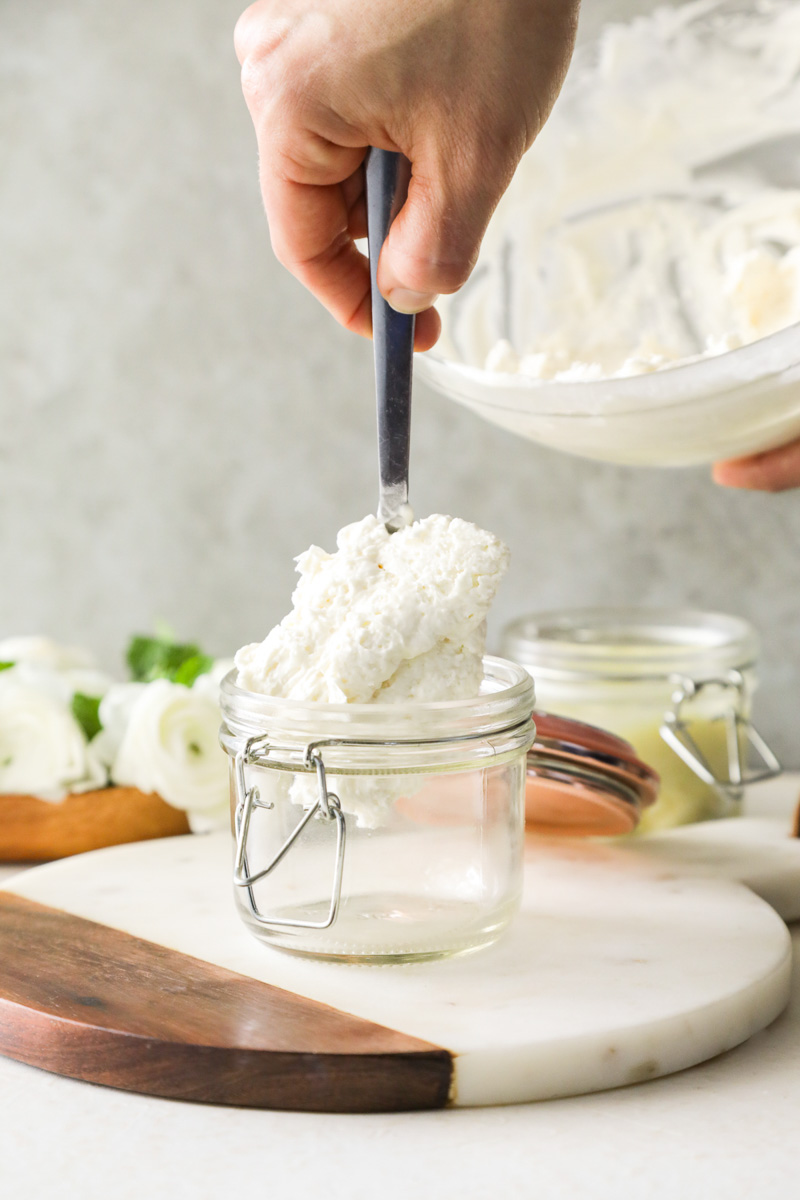
Step 6: Spoon Lotion into a Jar
Now you get to enjoy this amazing homemade lotion recipe and all its benefits (we’ll talk about the awesome benefits in a minute). Or, share the lotion as a gift.
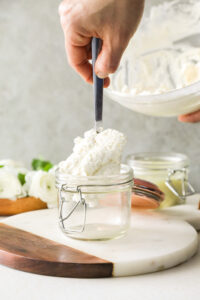
Choose a beautiful glass jar and spoon your creation into the jar. Add a label, if desired. And store the lotion at room temperature in a cool place (like a bathroom cabinet) for up to 6 months.
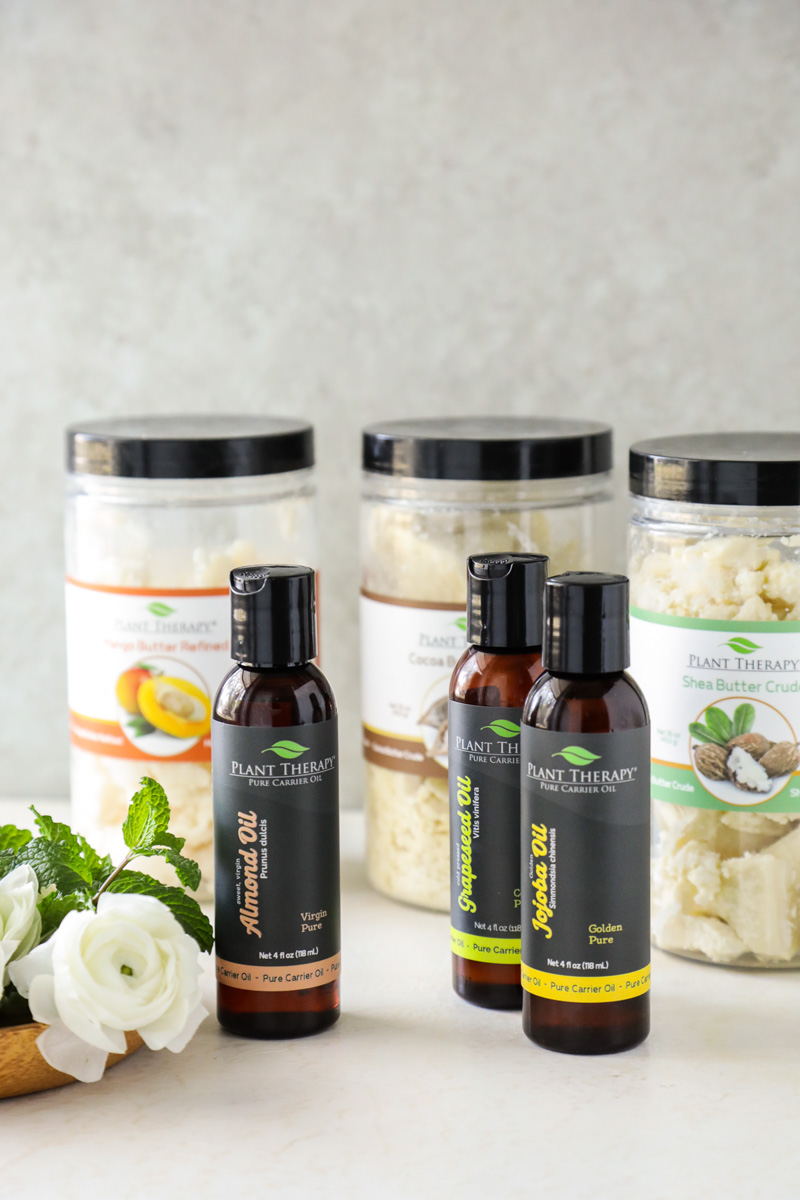
How to Choose a Carrier Oil
You can use shea butter alone as a body and face moisturizer, or you can mix it with a carrier oil to make a whipped body butter recipe or lotion (like this recipe).
Here’s what I recommend for a nourishing carrier oil to mix with the shea butter. The options absorb easily in the skin, making them the best options for a non-greasy lotion.
Jojoba Oil: Jojoba oil is made from a shrub that grows in Northern Mexico and the Southeast US. Jojoba is an emollient: a natural moisturizer that softens and moisturizes skin. Jojoba is the closest to our skin’s natural oil, making it ideal for all skin types.
Grapeseed Oil: This oil comes from pressed grape seeds. It has high amounts of fatty acids, vitamin E, and antibacterial properties. Grapeseed oil may be a great option for aging skin and for those with acne-prone skin.
Sweet Almond Oil: Made from sweet almonds and rich in vitamin A & E, fatty acids, and proteins.
Virgin Coconut oil is also an option, but as I’ll share in a minute, I don’t care for using coconut oil on my face. If you’re just using this lotion on your body, coconut oil may be a good option.
How to Use
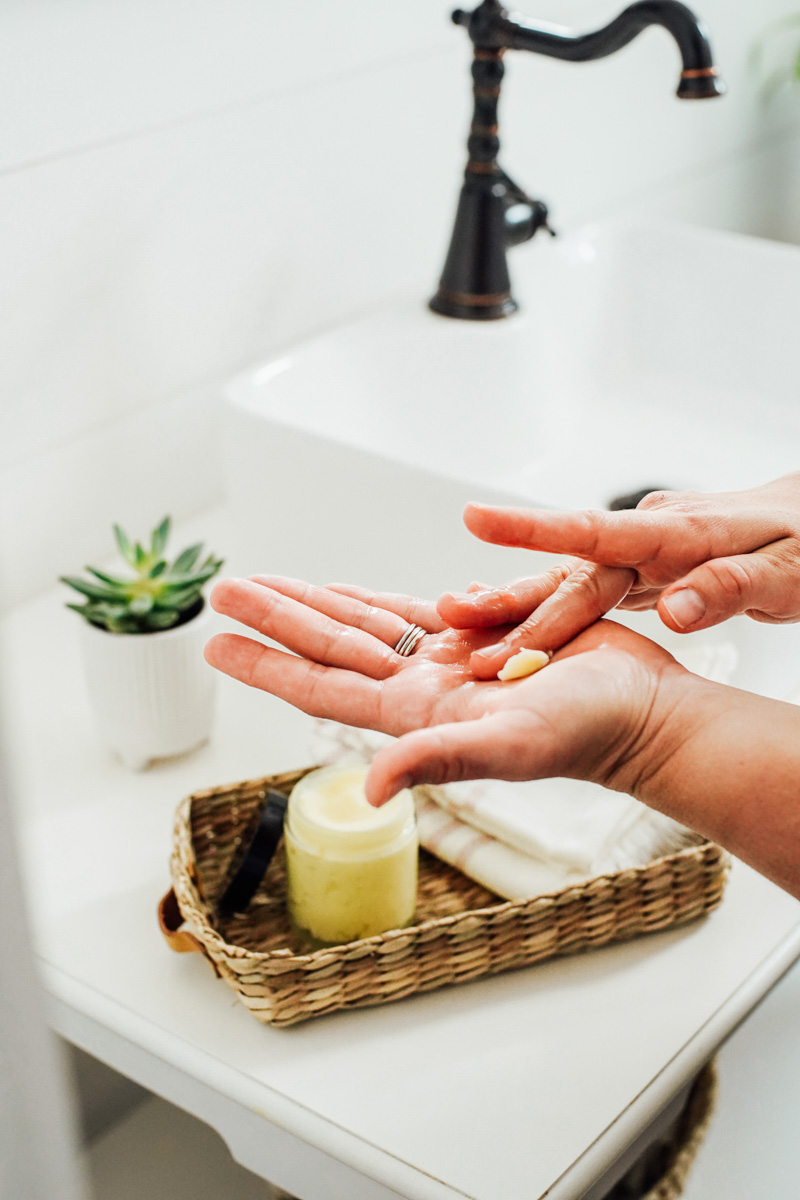
Scoop a small amount of shea butter lotion out of the jar using your finger, then rub between your hands. The heat from your hands will soften the shea butter. Massage into your skin: face, arms, legs, feet, dry patches, etc.
A little goes a long way.
For the face, apply this moisturizer after cleansing (my favorite natural face cleansers) and toning (a spritz of rose water is my favorite). If you use any serums, apply a facial serum before applying the lotion.
What’s the Shelf Life?
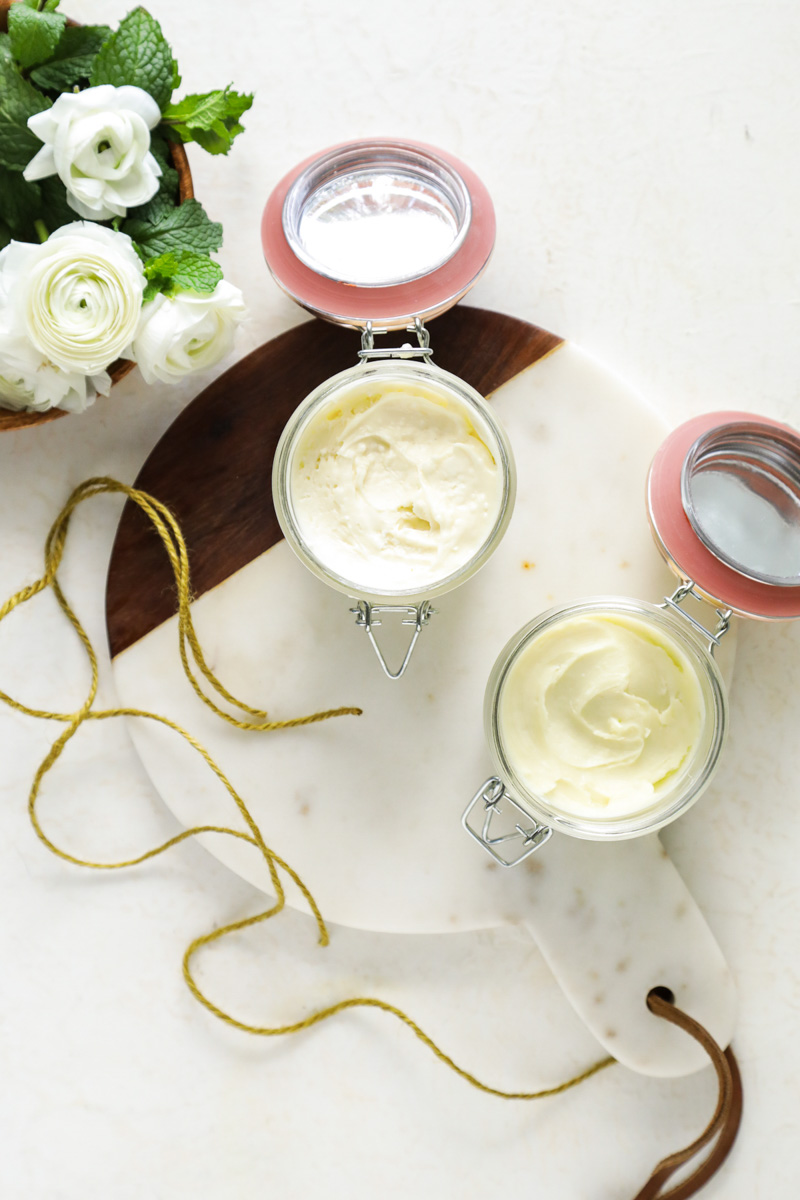
This natural lotion recipe doesn’t use any preservatives. Store-bought lotions add preservatives to formulas out of necessity. Without a preservative, mold and other bacteria will grow in a water-based lotion.
This recipe doesn’t need a preservative because it doesn’t use water in the formula. This means you can make a long lasting moisturizing lotion, without using any preservatives and don’t need to worry about mold growth. Woohoo!
Store the final product at room temperature, in a cool dry place, for up to 6 months. I recommend keeping homemade shea butter lotion away from heat, like a hot steamy shower, since it will melt slightly. This recipe is intended for home use; not to be sold commercially.
How to Add Essential Oils
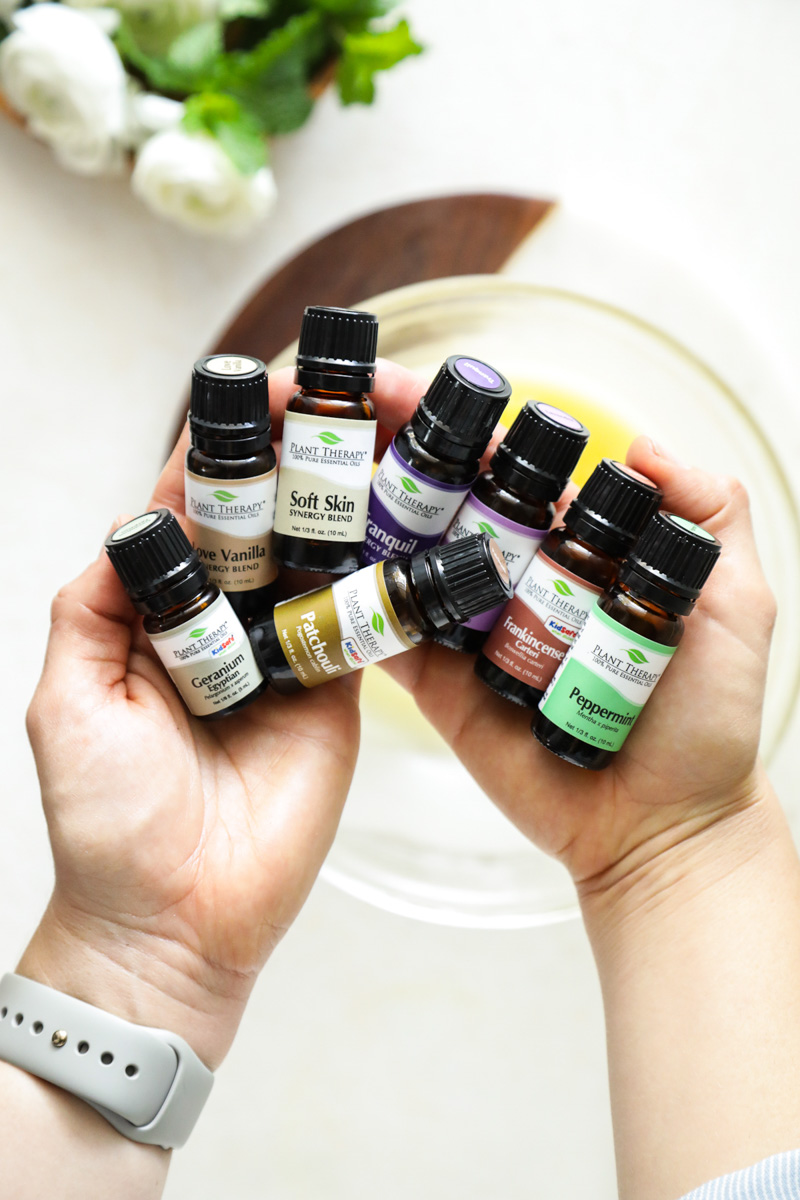
If you want to scent your own lotion, essential oils are the best way to do this! Along with their scent, essential oils are easily absorbed by the skin for nourishment, and provide antibacterial and soothing properties.
Add one essential oil or a combination of essential oils, totally 15 drops, to this lotion recipe. The best essential oils for homemade lotion are…
- Roman Chamomile
- Frankincense
- Lavender
- Rosemary
- Jasmine
- Carrot Seed
- Rose
- Lavender
- Tea tree
- Sandalwood
- Geranium
Essential Oils to Avoid: Avoid citrus essential oils (like lemon or orange essential oil) if you plan to wear this lotion during the day when exposed to the sun. Citrus essential oils are photosensitive and can cause your skin to develop a rash or sunburn.
Lotion Without Coconut Oil, Here’s Why
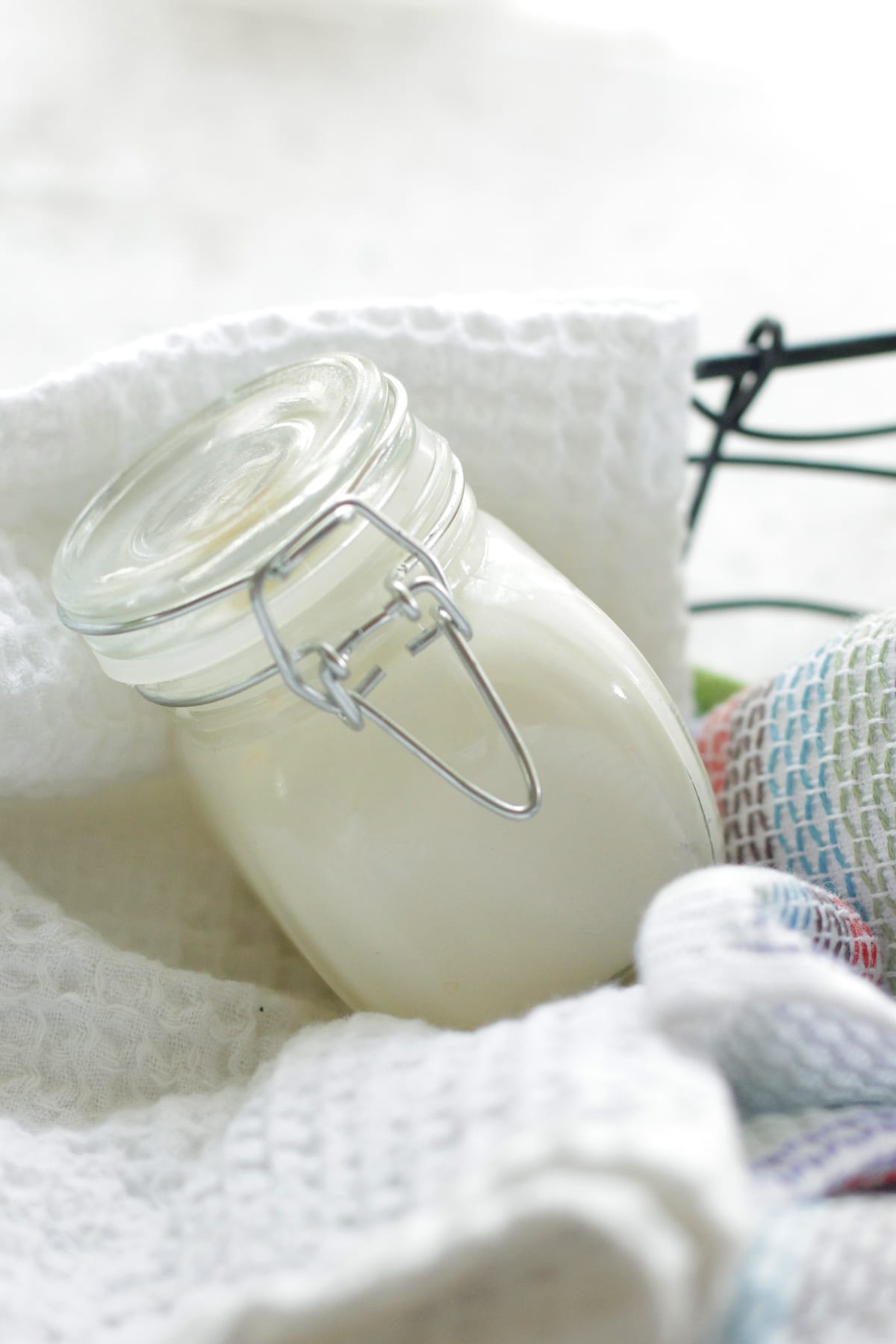
You’ll notice that this recipe doesn’t use any coconut oil. A lot of lotion and homemade whipped body butter recipes rely heavily on coconut oil.
Coconut oil is not the cure-all. Gasp, I know. That statement is practically heresy in the natural living community. Toothpaste? Coconut oil. Smoothies? Yep, coconut oil. A boo-boo? More coconut oil. We use it for everything! I’ve learned the magical oil isn’t always suitable for every need.
Many years ago, I decided it was time to ditch the toxins found in our bathroom. From lotions to body wash to makeup, the amounts of toxins I put on my body was astounding. With the urge for simplicity and natural living, I started developing my own replacements for things like foundation powder and lotion.
One of my very first DIYs was a simple homemade moisturizer using coconut oil. After a few weeks of using this moisturizer on my face, I experienced multiple break outs, daily peeling, and dry skin patches. Here’s why…
There’s nothing wrong with coconut oil, but from a skin care perspective, it’s not the best moisturizer option for the face. If you use it on your face, it’s likely to clog pores and cause breakouts due to its chemical composition.
Shea butter does not clog pores and is the best moisturizer option. So skip the coconut oil on your face and instead turn to shea butter and a non-clogging carrier oil!

FAQs
6 More Ways to Use Shea Butter
- Use shea butter to make homemade deodorant. You’ll also need arrowroot starch for homemade deodorant.
- Combine shea butter, coconut oil, and castile soap to make homemade moisturizing shaving cream.
- Combine butter, carrier oil, and beeswax to make Shea Butter Lip Balm or a custom DIY Lip Balm.
- Jojoba oil, coconut oil, shea butter, and soothing herbs come together to create DIY lotion bars.
- Shea butter, aloe vera, chamomile, and coconut oil make a fantastic homemade diaper rash cream.
- Use shea butter combined with mango butter and cocoa butter to make a customized body butter.
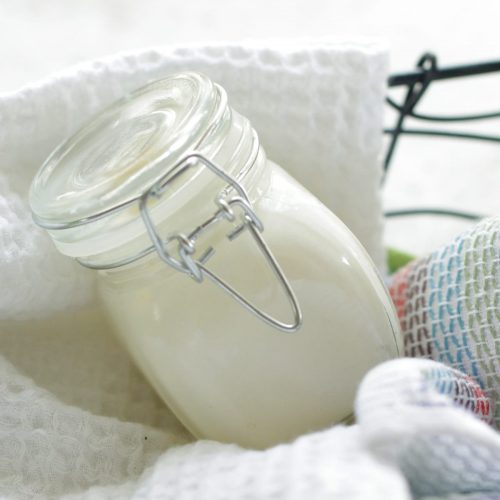
Homemade Moisturizing Shea Butter Lotion Recipe (Without Coconut Oil)
Equipment
- 1 electric mixer or fork
- 1 medium-size heat safe bowl
- 1 medium-size sauce pan
- 1 4-ounce glass storage jar (or larger)
Ingredients
- 1/2 cup shea butter (4 ounces)
- 1 teaspoon arrowroot flour starch (optional, to make a non-greasy lotion)
- 2 tablespoons nourishing carrier oil such as: jojoba, sweet almond oil, or grapeseed oil. This can even be coconut oil or olive oil (if not using on the face).
- 5 drops lavender essential oil optional*
- 5 drops rosemary essential oil optional*
- 3 drops carrot seed essential oil optional*
- 2 drops tea tree essential oil optional*
Instructions
Step 1: Melt Shea Butter
- To melt the shea butter, make a DIY double boiler. This will allow you to melt the shea butter without it directly touching the heat.
- Place a medium-size glass bowl over a sauce pan filled 1/4 the way full with water. The glass bowl should sit just on top of the saucepan, without touching the water in the pan.

- Over medium heat, allow the water in the saucepan to simmer. Then add the shea butter and melt.
- Once the shea butter has fully melted (about 2-3 minutes), turn off the heat and remove the bowl from the heat.
Step 2: Add Nourishing Carrier Oil
- Stir 1 teaspoon of arrowroot starch into the liquid oil of choice (grapeseed oil, sweet almond oil, OR jojoba oil) and whisk to combine. Pour the oil (and arrowroot starch whisked in, if using) into the shea butter.
- NOTE: You can skip the arrowroot starch and add the oil directly to the shea butter at this step. The arrowroot creates a non-greasy lotion.
Step 3: Cool
- At this point, the shea butter and oil mixture should be cooler (along with the bowl). If not, allow it to rest for a few minutes.
- Place the mixture in the fridge and allow it to solidify (about 30 minutes to 1 hour, depending on location in the fridge and temperature). Alternatively, speed up the process by placing the bowl in the freezer.
Step 4: Add Essential Oils
- Once the mixture is opaque and firm (not solid as a rock), remove the bowl from the fridge.
- Add the essential oil (or a combination of essential oils) of choice, if desired. Add up to 15 drops of skin-safe essential oils to this mixture. A few of my favorite essential oils to add are listed in the recipe above. You can add your favorite essential oil or oils, not the ones listed above (if desired).
Step 5: Whip
- Use the whisk attachment and an electric mixer, hand mixer, or a fork to whisk the mixture until it appears "whipped." This doesn't take very long, just a few seconds using a mixer and a bit longer with a fork.
Step 6: Store
- Choose a beautiful glass jar (4 ounces or larger) and spoon your creation into the jar. Add a label, if desired. And store the lotion at room temperature in a cool place (like a bathroom cabinet) for up to 6 months.
Video
Notes
- Roman Chamomile
- Frankincense
- Lavender
- Rosemary
- Jasmine
- Carrot Seed
- Rose
- Lavender
- Tea tree
- Sandalwood
- Geranium
Natural Body-Care Simplified
Learn how to make your own body and beauty products with simple ingredients.

Yes! A recipe I could actually use (that is, without coconut oil, it doesn’t go well with me at all). Thanks a lot for this recipe.
I want to find out if I can substitute the Shea Butter with mango butter, because it is what I have….and I will also like to find out from the readers, if anyone has used the mango butter and if it came out nice?
Hey Ella, I’ve heard from a few readers who used mango butter with success. Maybe someone will comment with their experience :). I’m glad you can use the recipe!
Glad I found this. I am black woman with infant twins; we all have dry, sensitive “ashy” skin. It could be because of the winter season, but I haven’t used lotion in about 2 or 3 years to prevent exposure from harsh chemicals. I would usually just coat my skin, hair, and lips with coconut oil after bathing, and started implementing this method with my children. I’m noticing, however, that our skin and hair are both excessively dry in the morning. Would you mind if I used this recipe and reviewed the results on my blog (linking to your site, of course)?
Also, if one does not have a stand mixer, how would that affect the outcome?
Hey Ariana, I hope this lotion is the solution you’re looking for.
Due to copyright laws, you can’t share the actual written recipe and directions on your blog, but a review linking to the original recipe and post is perfectly fine. Thank you for asking.
Ariana, you’re probably experiencing extreme dryness because you cannot moisturize your skin with an oil. Oils like coconut oil help the skin retain moisture by creating a barrier, but do not actually moisturize. Most moisturizers are made up of humectants, occlusives, and emollients. Only humectants (like glycerin and hyaluronic acid) moisturize the skin. Oils fall into the occlusive and emollient categories.
What brand would you suggest for a person who is just starting? Thanks 🙂
Hey Adwoa Odoom, Are you looking for a lotion brand, or product brands to make your own lotion?
Sorry I meant was there any specific brand of essential oil that you used because this this my first time trying this. Thanks 🙂
Hey Adwoa Odoom, I personally like Plant Therapy and Aura Cacia.
Hey livesimply crew ❤️
I had a field day and made your body scrub, astringent & this lotion. I’m not sure what to blame but the scrub or the lotion is causing my eczema to flair on my upper arms. Any chance you know what ingredient could be causing this? I love the concept but it’s not doing a thing to penetrate the dry spots ????
Hey Lindsay, I’m not sure which ingredient may be causing the eczema flare-up since everyone’s skin (and products used) can be so different. Maybe you’re allergic to an ingredient? I would discontinue using the products, then slowly once the eczema has healed, try each one by itself to rule out which product/ingredients may be causing a reaction, like an elimination diet (just the opposite method ;)).
Thank you Kristin! Hope to continue the DIY products in my home if my skin will just get on board! 😉
Wonderful, Lindsay :)!
Hi, I’m wondering what is the shelf life and storage guideline for this lotion? Since it has no preservative in it except for some antioxidants, how long can I use it for? Thanks !!
Hey Jenny, As long as water isn’t introduced into the mixture, the lotion should last about 12 months.
Hi, I made this moisturizer last night. I used mixer to make it creamy. However, when I was about to use it this morning, it becomes solid again, which is not so easy to apply. Is that same for yours? Thanks.
Hey Tony, That is pretty typical for this lotion. It should be hard, but spreadable on the skin. I personally think a colder environment (hey, wintertime) also effects the hardness of the lotion. Here’s another option that’s a bit softer: https://livesimply.me/2015/08/26/easy-homemade-lotion/.
So why isn’t olive oil in your default recipe as its probably the most superior ingredient one could ever have in a moisturizer recipe. I can tell you don’t eat, and perhaps your should as olive oil is great for skin, hair, bones, nails…I mean it seriously rocks for your health and skin condition.
Hey John, You’re welcome to use olive oil as the nourishing oil. I use olive oil in my facial cleanser: https://livesimply.me/2015/10/07/homemade-honey-and-aloe-facial-cleanser/. Everyone has a different opinion when it comes to which oil they like to use in their homemade lotion.
I read a couple of comments about it and have to say, my lotion is rock hard as well. Made it to use it on my babies mainly but that isn’t really an option now. Can’t get them to hold still long enough until it’s melted in my hands… 🙂 Did I whip to long, to short , any other idea?
Thanks
Hey Melanie, Yes, my guess is that the lotion was whipped too long, but the cold weather (if it’s really cold in your home) may also have something to do with the hard-as-a-rock texture… just a guess. You could try melting it back down and adding a bit more nourishing oil.
This isn’t a lotion, but rather a whipped butter. Lotions have water and an emulsifier wax to them. The Shea butter is what is keeping this so thick and together, but it is heavy and greasy. You need water and a preservative to be a lotion.
Thanks for sharing your thoughts, Marilyn.
I’m not sure if you tried the recipe or not, but it shouldn’t be greasy or too thick once it’s applied to the skin.
Hi Kristin!
You call for “carrot seed oil” …does that mean carrot seed essential oil? Or just carrot seed oil?
Hey Brianna, Yes, carrot seed essential oil :).
I noticed that some people have mentioned they want a recipe that can go into a pump dispenser and that you were looking/testing for recipes. I was wondering if you have tried any of the recipes in the “Better Shea Butter” Ebook? I received this free when I purchased my first thing of Raw Shea Butter from Amazon and I find it so informative! I love that they provide their customers with this. In the book, they have a recipe called Green Tea Lotion, which is the only recipe in the book containing water. They recommend it be used in about three months. I have just tried it and substituted some of the ingredients with what I had. Just thought I would mention it! Love everything about your blog! Thanks for sharing with us readers! I have purchased your ebook and will be starting the process of cleaning out my pantry/fridge after my wedding in November. I can’t wait to start the real food challenge.
Hey Annie, I haven’t tried any of the recipes in the book, yet. Thank you so much for suggesting the book–I agree, I love the Better Shea Butter customer service! Congrats on your wedding in November. Enjoy the Challenge!!
im so gonna try this. I too think coconut oil feels a little too greasy if too much is used but I don’t want a hard lotion either. do you think I could use 1/4c shea butter and 1/4 cup coconut oil and that will soften it up some?
Hey Krystle, 1/4 cup shea and 1/4 cup coconut oil would be great! I would probably whip the mixture together with a mixer so it’s nice and fluffy.
Thanks!! Imma make some right now!!!
I just made some using the 1/4c Shea butter, 1/4c coconut oil, 2 Tb sweet almond oil. I didn’t have any of the EOs you mentioned so I put in some vitamin E oil, lemon EO, jasmine EO, and a small touch of Texas cedar wood! Smells delicious and actually came out pretty smooth bc I mixed it for a while. May actually go well in a sneeze bottle. For anyone else, I really would t recommend jasmine EO. It took WAY more than what I initially thought and it still only had a very faint smell. That’s why I added the Texas cedar wood but only like 5 drops and it all balances out pretty well! Felt a little greasy when I 1st out it on my arms but it adsorbed fast and feels so good now!! Thanks for the sharing!!
Awesome, Krystle! Thank you for sharing!
Hi Kristin, Tons of information… Thank you! I did finally find a “pumpable” shea butter lotion that doesn’t have any junk in it, ozone layer hand and body lotion, which fits my two requirements 1. Only shea butter (I can’t use coconut oil) and 2. Does it pump?
I hate to sound cliche “I don’t have time to make lotions” Maybe I should re-prioritize! Thanks again for the recipes
Hello! I just started transitioning to all homemade products from cleaning to beauty and I love your recipes. This was my second attempt at homemade lotion and I did a slight variation to yours. I used my raw Shea butter, same amount, did two tablespoons of coconut oil, 15 drops lavendar, 5 drops tea tree along with 5 drops of skin care eo that I use daily on my face. It came out to thick so added one tablespoon of fractionated coconut oil. It turned out basically like my first batch I tried from another site. My question is 1) is there a difference from using the fractioned oil to the regular cocunut oil? And 2) mine always turn out yellow not white like everyone I see posted? Why is this? And 3) is it the coconut oil that makes the lotion somewhat greasy or my raw Shea butter? Any insight would be so greatly appreciated! My 8 month old battles with skin sensitivities and mild eczema so I’m trying to find a perfect mix I can apply to him multiple times daily that has same benefits of the lotion I made but maybe not so greasy.
Hey Cassie, Here are a few answers 🙂
1. The fractionated coconut oil is liquid (will remain in the same liquid state despite temperature changes) due to the processing. The fractionated oil is perfect to use in liquid DIY recipes: liquid soaps, body wash, etc. Virgin coconut oil (will change from solid to liquid depending on temperature) can be used for lotions, lip balm, and cooking.
2. Two factors play into the color of the lotion. I used refined shea butter to make the lotion in the pictures found in this post, hence the white color. Unrefined (which is my preference now) will produce a more yellow product. You can see the yellow color in the video post here: https://livesimply.me/2014/11/18/how-to-make-homemade-ultra-moisturizing-lotion-without-coconut-oil/. The oil used will also change the yellow hue of the lotion. White or yellow are normal :).
3. The shea butter can feel greasy and should absorb into the skin within a few minutes. I personally think coconut oil has a drying effect when applied to the skin, but others express a greasy feeling. It may be either ingredient. With shea butter lotions/body butters, a little bit goes a long way. If you have any arrowroot flour/starch you may be able melt the lotion back down and whisk it into the lotion–this may help with the greasy feel.
Is it okay if I substitute another essential oil. Since I’m using one essential oil how many drops should I put in
Hey Luke, Yes, you can use one essential oil or none. Here’s a handy dilution chart to determine how much essential can be used: http://essentialoilblogging.com/2013/12/04/essential-oil-dilution-chart/
Hi, I am enjoying your blog & I’m just waiting for some ingredients to arrive from Amazon before I try this recipe!
I’ve been reading around about xenoestrogens & to my shock, both lavender & rosemary are listed among them (sage & tea tree too in case you’re interested). It’s especially noted that topical application is a bad idea if you have estrogen dominance or are just trying to balance your hormones. Dr Peter Eckhart advises to stay away from them too. So I just thought I’d let you know in case you or any readers here are trying to avoid them like I am. I’ve been using Dr. Bronner’s lavender soap for ages & I love it, but now I have to give it up. I can’t wait to try this recipe, I’ll just have to substitute the oils for other varieties – not sure which ones yet.
Keep up the good work! 🙂
Awesome recipe!! thanks a lot!!! can I use coconut oil + beeswax instead of shea butter? I want to use what I already have.
Hey Cynthia, Thank you. You can use the coconut oil alone. Or add the beeswax for more of a hard lotion.
Hello, I am very interested in making your coconut oil free lotion but I have a question that I was hoping you could help me with. My daughter is allergic to peanuts and we avoid tree nuts as a precautionary measure. My research shows me that some people with nut allergies can have reactions to Shea nuts as well. Do you know if there is a substitute to Shea butter?
Robin Ori
Hey Robin, You could use Mango Butter instead :).
I am wondering if there is a recommendation for substituting some of the essential oils in the recipe? I am a fan of peppermint and lemongrass, but I am allergic to lavender. Is there a reason to use the specific essential oils outlined in the recipe or could there be substitutions? Please advise. 🙂
Hey Teresa, I recommend using this recipe as a base and adding the essential oils you enjoy! Also, take into consideration safety and oils that are beneficial for the skin. The oils could also be left out :).
Thanks Kristin, that helps! So, if I were to make a body wash or face wash (which would include water) how long do you think that would be stable for? I’m trying to figure these things out, but there’s so much information out there, it’s difficult to get the facts! I appreciate your feedback! 🙂
Hey Rosie, The body wash will keep for 2-3 weeks. The shelf-life is shorter for this product due to the coconut milk. One of the best ways to keep it fresh is to freeze half the body wash and then defrost in the fridge when needed–that way you can make as much as desired and just pull it out when needed. Once defrosted, I keep it in the bathroom for a max of two weeks.
The face wash doesn’t contain a sensitive ingredient, like coconut milk. I keep my face wash on the bathroom counter for about 6 weeks at a time. You can also add about a teaspoon of Vitamin E, or the other oils mentioned (above) to help preserve it during this time.
Most homemade products are evaluated on a case by case basis when determining shelf-life and the need for a natural preservative. I always take into account the ingredients and ask, “Are these ingredients shelf-stable? Or do any of these ingredients suggest refrigeration/quick use?”